Pantry Notes
The world’s everyday cinnamon, grown where the rain almost never stops.
Reach for a jar marked simply cinnamon and the chances are you are holding cassia, the bold, sweet, reddish kind that flavours most of the world’s chai, curries and warm bakes. Almost none of it grows in India. This is the story of the rare Indian cassia, foraged in the hills of Meghalaya, and of a spice once so valuable that traders hid where it came from behind tales of giant birds and cliffs no one could climb.
Where the rain almost never stops
Meghalaya means the abode of clouds, and it earns the name. The state sits on the Shillong Plateau in Northeast India, a green wall of hills about fourteen hundred metres high that takes the monsoon full in the face as it sweeps up from the Bay of Bengal. Two villages here, Mawsynram and Sohra, trade the title of the wettest inhabited place on earth, each soaked by close to twelve thousand millimetres of rain a year. The British renamed Sohra as Cherrapunji; Meghalaya gave it back its older Khasi name in 2007.
The cinnamon grows in this wet, misted world. It is not a plantation crop here. It grows wild and semi cultivated through the hill forests, foraged and tended by Khasi families the way it always has been, organic by long habit rather than by paperwork. The constant rain, the cloud and the altitude all slow the tree down, and a slow tree puts more of its warm, aromatic oils into its bark. Not farmed so much as found.
Sohra, in the East Khasi Hills, still holds the world record for the most rain in a single year, more than twenty six thousand millimetres measured between August 1860 and July 1861. To keep working through the downpour, people in these hills have long carried the knup, a full body umbrella woven from bamboo and banana leaf.
What we call it
Across India, cinnamon answers to a different name in almost every kitchen.
Malayalam Karuvapatta · Telugu Dalchina Chekka · Kannada Dalchinni · Gujarati Taj
The Hindi name carries its own history. Dalchini comes from the old Persian darchini, which means Chinese wood, the name the spice travelled under when it reached India overland from China many centuries ago. It is a fitting name, because the cinnamon most of us cook with is cassia, known to botanists as Cinnamomum cassia and for a long time as Chinese cinnamon. The Khasi of Meghalaya call the tree Dieng-lorthia, dieng being simply their word for tree.
The oldest trade secret
Cinnamon is one of the oldest spices people wrote about, traded for some four thousand years and named in ancient Egyptian records and in the Hebrew scriptures, where it scented sacred oil. For much of that time it was worth close to its weight in gold, and the people who sold it went to remarkable lengths to keep its source a secret.
The Greek historian Herodotus, writing in the fifth century before our era, passed on the tale that giant birds carried cinnamon sticks to nests on cliffs no person could reach, and that gatherers lured the birds down with great chunks of meat until the nests, grown too heavy, fell to the ground. Other merchants spoke of valleys guarded by serpents. These were not idle stories. Arab traders moved cinnamon through the port of Alexandria and spread such myths on purpose, to hide the real route and hold the price high, until the Roman scholar Pliny saw through the whole performance and wrote that the tales were invented to raise the cost.
The truth was plainer, and it is written into the spice’s own name. The word cassia comes from a Semitic root meaning to strip off bark, the exact thing a cinnamon gatherer does. No birds, no serpents, just a knife and a tree.
Two cinnamons, and how to tell them apart
There are really two cinnamons in the world, and once you know the difference you will spot it on any shelf. Cassia, the kind from Meghalaya, comes from Cinnamomum cassia. Ceylon, often sold as true cinnamon, comes from a different tree, Cinnamomum verum, native to Sri Lanka. They are cousins, not twins.
The flavour of cinnamon comes mostly from one compound, cinnamaldehyde, the thing your nose recognises the instant you open the jar. The more of it a cinnamon carries, the bolder it tastes, and cassia carries a great deal: its bark oil runs to around eighty five per cent cinnamaldehyde, against roughly half that in delicate Ceylon. That is why cassia is the bold, sweet, gently fiery cinnamon with a woody depth and a faint citrus edge, while Ceylon is light, soft and almost floral.
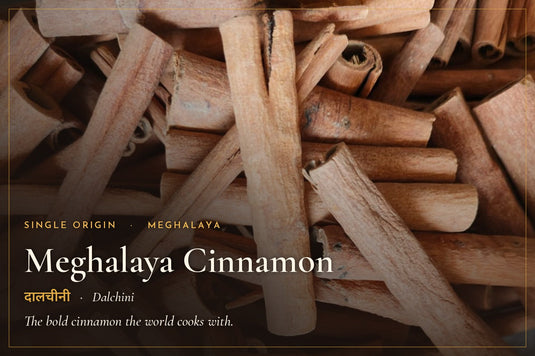
Telling them apart is easy once you look. A whole cassia quill is a hard, dark reddish brown bark that rolls into a single thick curl. A Ceylon quill is pale tan and made of thin, papery layers rolled together like a cigar. As a powder they look closer, but cassia is the darker, redder one, and it smells louder. The simplest test of all is the label. If it does not say Ceylon or Cinnamomum verum, it is cassia, which is about nine in every ten cinnamon sticks sold in the world.
The bold cinnamon you taste in a garam masala, or in a Chinese five spice blend, is almost always cassia rather than Ceylon. Its strength is exactly what those blends need, a cinnamon that can hold its own beside clove, star anise and pepper rather than disappear into them.
Why we send it single origin, and ground fresh
Almost all cassia is anonymous. It is grown in China, Vietnam and Indonesia, pooled across farms and countries, and ground into a powder that tells you nothing about where it came from. Ours does not work that way. It is one cinnamon from one place, the hills of Meghalaya, foraged from wild and semi cultivated trees rather than raised on a plantation.
We sell it as a powder because that is how most kitchens use cinnamon, stirred into batter, folded into masala, whisked into chai, where a whole quill can never reach. Cassia bark is also hard and dense, far harder than brittle Ceylon, so it grinds rough and uneven at home. A clean mill gives a fine, even powder that blends without grit, and we grind in small batches and seal it straight away so the warm oils do not fade on a shelf. You can read the full sourcing and grade detail on the Meghalaya Cinnamon Powder product page.
Cooking with Meghalaya cinnamon
Cassia is the cinnamon Indian kitchens were built around. A small piece bloomed in hot oil or ghee at the start of a biryani or a pulao perfumes the whole pot, and a pinch of the powder is the sweet, woody backbone of a good garam masala. Stir it straight into masala chai, where it holds its own against ginger and cardamom rather than washing out.
In baking, reach for it when you want the cinnamon to be felt, in cinnamon rolls, apple pie, banana bread and oatmeal cookies. It is just as at home in a pot of mulled wine or spiced cider, or in a long, slow braise where its robust sweetness carries all the way through the cooking. Because it is bold, you need less than you think, so start small and taste. It sits happily beside the other warm spices, clove, cardamom, nutmeg and pepper.
A cinnamon with an address
Most cinnamon is anonymous, a brown powder from nowhere in particular. This one has an address, a wild tree in the wettest hills on earth, foraged by the people who have always known it. Grind it into your next pot of chai and you will taste the difference between cinnamon in general and a cinnamon from somewhere. Try our Meghalaya Cinnamon Powder, or browse the rest of the single origin collection.
From Our Shelf