


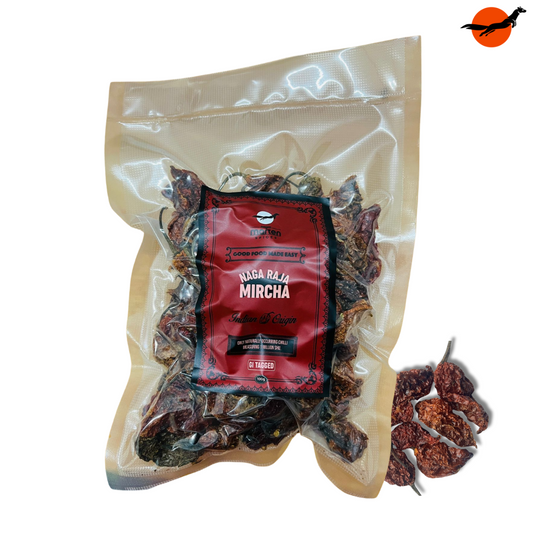
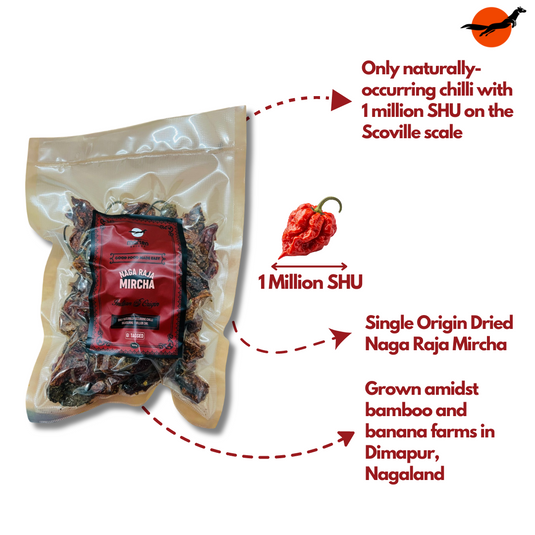


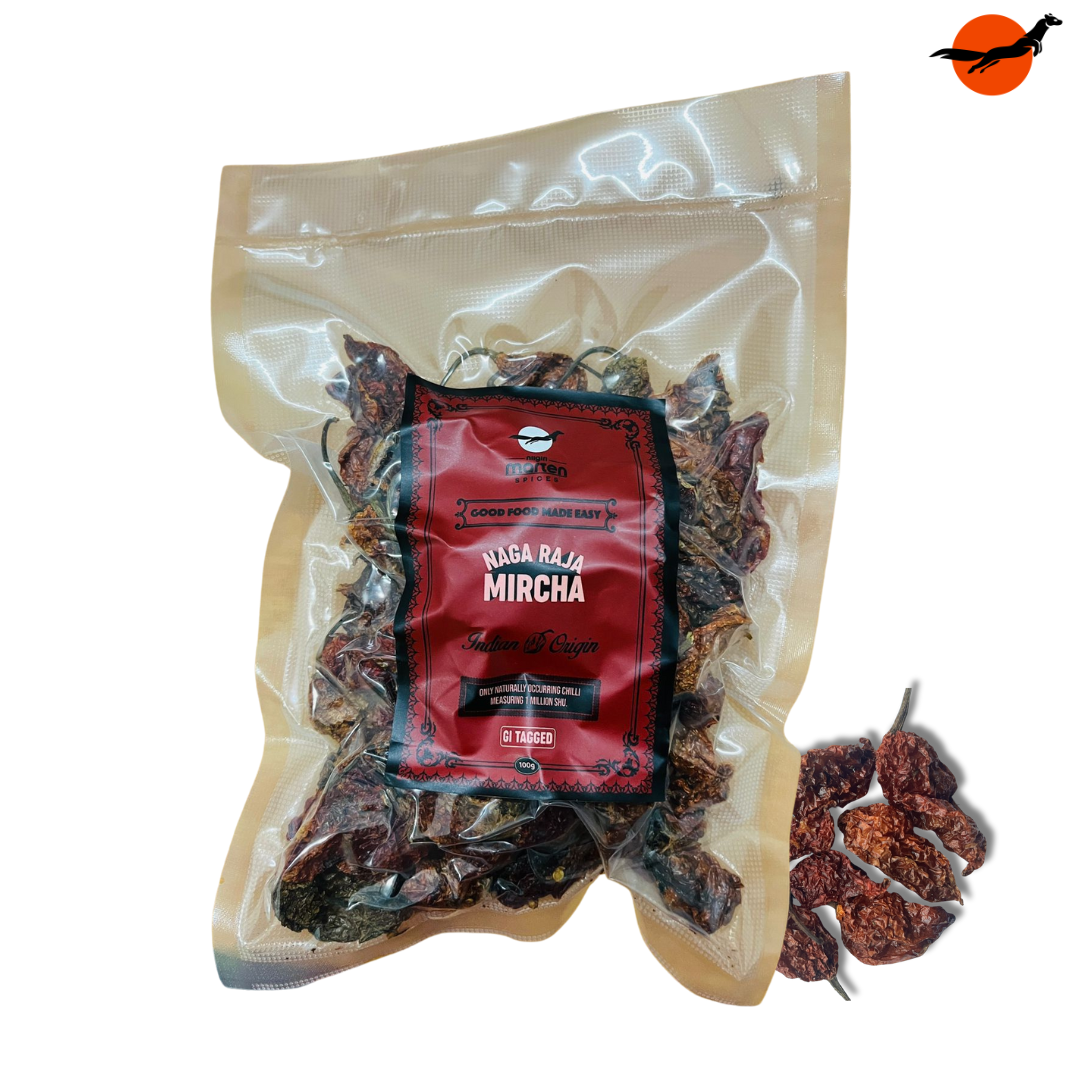
Naga Raja Mircha | Ghost Pepper (Bhut Jolokia) Whole Dried, GI Tagged Nagaland
We will send you a notification as soon as this product is available again.
Guarantee safe and secure checkout
-
Estimated delivery: Oct 09 - Oct 13
-
Free return within 30 days of purchase.
Product description
India’s Only True Chilli, and the Original Superhot King
Here is something most people do not know. Every chilli in your kitchen came from Mexico. Every single one, except this one. Naga Raja Mircha, known to the world as the Ghost Pepper, is the only chilli that evolved in India rather than being carried here, and the only superhot on earth that nature made instead of a laboratory.
SHU is the Scoville scale, the standard measure of chilli heat. For context, a jalapeño and a dash of Tabasco both sit near 5,000. Naga Raja Mircha was the first chilli ever verified past one million.
While every other chilli species came out of the Americas and reached India with Portuguese traders around 1500 AD, this one developed on its own in Northeast India, through centuries of cross pollination. Genetic analysis settled it. Naga Raja Mircha is a naturally occurring interspecific hybrid found nowhere else on Earth, which makes it the only chilli that is truly made in India. Whether you are a heat seeker pushing your limits, a cook after authentic fire, or someone who simply cares about the story behind what they eat, this is a pepper no other can match.
The Pepper That Evolved, Not the One That Arrived
Somewhere around 1500 AD, Portuguese ships brought Capsicum seed across the ocean. It spread through the subcontinent, adapted to local soils, and became the heat behind dishes that now feel timeless, the vindaloo, the Chettinad curry, the Kolhapuri mutton, all of them built on a New World import. Every chilli in India traces back to that moment. Except one.
Deep in Nagaland, far from the port cities where those ships docked, a different kind of pepper was already growing. Not brought, not introduced, but evolved. Naga Raja Mircha is a natural hybrid of Capsicum chinense and Capsicum frutescens, and the genetics confirm what local farmers always knew. It exists nowhere else on earth. It evolved here, in the rolling hills where tribal communities have grown it for generations.
The Place You Cannot Replicate
What makes this pepper so extraordinarily potent? The answer is an inseparable combination of nature and heritage that simply cannot be copied anywhere else. The heat is born of a very particular ground.
- Clay loam soil. With a pH between 5.5 and 6.0, in plots grown alongside bamboo and banana in Nagaland.
- Heavy rain. Around 1,800mm a year, at tropical intensity.
- A steady warmth. A temperature range of 20 to 30 degrees Celsius through the year.
- Jhum cultivation. Traditional shifting cultivation, two years of growing followed by a nine year fallow, where ash from controlled burning feeds the soil with natural potassium.
Why origin is the whole story
In 2005, New Mexico State University ran an experiment that should have settled any debate about origin. They took Naga Jolokia seeds and grew them in Gwalior instead of their native Tezpur in Assam. The result was a fall in heat of more than fifty percent. Same seeds, different soil and climate, half the fire. This is not marketing mythology, it is measurable chemistry. Capsaicin, the compound responsible for heat, develops differently with soil, stress and climate, and Nagaland’s combination cannot be replicated. Buy a ghost pepper grown elsewhere and you are buying a diminished version. The name is the same. The pepper is not.
The Original, Beside the Imitations
Today’s superhot market is full of lab bred varieties, peppers engineered generation by generation to chase a single number. It helps to know where the original sits among them.
Lab bred superhots, selected in controlled conditions to maximise heat. Almost all of them carry Naga genetics as a parent.
Over a million SHU, reached by nature alone over centuries. The original superhot and the genetic ancestor the record breakers were built from.
Around 5,000 SHU. Naga is roughly 170 to 400 times hotter, in a different league entirely.
The Record: When Science Caught Up
In 2007, Naga Raja Mircha made history as the first pepper to officially break one million Scoville Heat Units, taking the Guinness World Record for the hottest chilli on earth. Independent laboratories have verified its potency time and again.
- Chile Pepper Institute, 2005. 1,001,304 SHU.
- Frontal Agritech India, 2004. 1,041,427 SHU.
- Defence Research Laboratory, Tezpur, 2004. 855,000 SHU.
The heat comes from an extraordinarily high capsaicin content, 2 to 4 percent against the 0.1 to 0.5 percent of a typical hot pepper, with total capsaicinoids reaching around 5.36 percent, some 338 times that of a Scotch Bonnet.
What sets it apart from other superhots is the delay. Unlike peppers that hit at once, the burn from Naga Raja Mircha creeps up 15 to 45 seconds after you taste it, sneaking up like a ghost. You taste sweetness first, maybe a little smoke, a hint of fruit, and think it was not so bad. Then the heat arrives, creeping, building, overwhelming. It is why the mistranslation of Ghost Pepper turned out to be accidentally perfect.
Legally Protected: GI Certificate #99
On 2 December 2008, Naga Raja Mircha received official Geographical Indication protection from the Government of India, Certificate Number 99. That was not just a certificate, it was history. It was the first product from Nagaland to ever receive GI protection, and one of only six Indian chillies to hold the distinction. The tag means that only chillies grown in Nagaland, by local farmers using traditional methods, can legally be called Naga King Chilli or Bhut Jolokia, in the same way that only sparkling wine from one French region can be called Champagne.
- Certificate number. 99.
- Registration date. 2 December 2008.
- Valid until. 21 August 2027.
- Protected area. The state of Nagaland exclusively.
- Applicant. Department of Horticulture and Agriculture, Government of Nagaland.
Sixteen Tribes, Sixteen Names, One King
Across Nagaland’s hills, sixteen distinct tribal communities have cultivated Raja Mircha for generations, and each tribe has its own name for the crop. Every name carries respect, because this is not just a crop, it is cultural heritage.
- Raja Mircha (राजा मिर्च). King of Chillies, the common name.
- Chüdi. King of Hotness, in the Angami tongue.
- Chaibe-ra-tsi. Leader or Chieftain, among the Zeliangrong.
- Umorok. The regional name in Manipur.
The Assamese name carries another layer. “Bhut Jolokia” (भूत जोलोकिया) is usually read as Ghost Pepper, but that reading is a charming accident. “Bhut” most likely points to the Bhutanese traders who once carried these peppers along old routes, and Western translators heard it instead as भूत, the word for ghost. The blunter Assamese name leaves no room for confusion at all, “Bih Jolokia,” Poison Chilli. We source ours directly from farmers in Dimapur, where the knowledge of when to harvest, how to dry and which seed to keep has been handed down through generations, a living library of agricultural wisdom.
Not by certificate
Here is something worth pausing on. Naga Raja Mircha does not need to convert to organic farming, because it already is. The jhum system used by Naga farmers, shifting cultivation with long fallow periods, has sustained this crop for centuries without a single synthetic input. As APEDA officially confirmed in 2021, these peppers are grown organically by default. The controlled burning during jhum leaves potassium rich ash that fertilises the soil, and traditional practice meets international organic standards without any modification. This is not organic farming as a premium upsell. It is organic farming as it has always been done.
Beyond the Kitchen: Grenades and Elephants
The extreme potency of this pepper drew attention far beyond food. India’s Defence Research and Development Organisation has built non lethal tools around Bhut Jolokia, including 81mm chilli grenades for anti terrorist operations, pepper spray for women’s self defence, and smoke bombs that can blind night vision devices. As Dr R. B. Srivastava of DRDO put it, the pungent smoke forces a hideout empty and causes choking and streaming eyes with no lasting harm.
Gentler uses run alongside the fierce ones. For generations, farmers in the Northeast have used Raja Mircha to keep wild elephants off their crops, humanely. Chilli paste is smeared on fences, and dung bombs are made from dried elephant dung mixed with ground ghost pepper. The practice has since hardened into formal deterrent systems near Kaziranga National Park. An elephant’s trunk holds thousands of nerve endings that are acutely sensitive to capsaicin, which makes this an effective and humane solution. In the kitchen, Naga cuisine treats it the same way, sparingly but essentially, lending depth to smoked meats, fermented bamboo shoot curries and traditional pork. A little goes an extraordinarily long way.
The Woman Who Outlasted Gordon Ramsay
On 9 April 2009, the world’s most famous chef was filming in Jorhat, Assam, when someone handed him a single Bhut Jolokia. Gordon Ramsay took a bite, screamed that it was too much, and reached desperately for water. Standing beside him was Anandita Dutta Tamuly, a 26 year old homemaker from Titabor. While Ramsay struggled with one pepper, she ate 51 Ghost Peppers in two minutes, and was actually disappointed, having managed 60 in 2006. She did it without tears.
Her backstory explains it. At the age of five, her mother applied chilli paste to cure a tongue infection, and from then on she ate Bhut Jolokia with salt every day. While other children looked for berries, she once told reporters, she foraged for ghost peppers. This is the pepper that separated the world’s most celebrated chef from a village homemaker with a single bite.
Why Choose Our Naga Raja Mircha
- Native to India. The only chilli that evolved on Indian soil, rather than arriving from the Americas.
- Naturally evolved. The only superhot on earth that nature made, while every rival was bred in a laboratory.
- Verified heat. Independently tested past one million Scoville units, and a former Guinness World Record holder.
- GI tagged. Certificate #99, the first product from Nagaland to ever hold a Geographical Indication.
- Organic by tradition. Grown by jhum cultivation with zero synthetic inputs, organic by default and not by upsell.
- Single origin. Sourced directly from farmers in Dimapur, Nagaland, with traceability from soil to shelf.
- Sold whole. Whole dried pods, never pre ground, so you control both the heat and the freshness.
The original king. The one that started it all. Everything else is just trying to keep up.
| Type | Whole dried superhot chilli, Naga Raja Mircha (Bhut Jolokia, Ghost Pepper) |
|---|---|
| Origin | Dimapur, Nagaland, Northeast India |
| Botanical name | Capsicum chinense × Capsicum frutescens, a natural interspecific hybrid |
| Also called | Raja Mircha (Hindi), Bhut Jolokia and Bih Jolokia (Assamese), Chüdi (Angami), Umorok (Manipuri) |
| GI status | Geographical Indication, Certificate #99, registered 2008, Nagaland |
| Heat | Extreme, over 1,000,000 SHU, with a 15 to 45 second delay |
| Capsaicin | 2 to 4 percent, total capsaicinoids around 5.36 percent |
| Tasting notes | Sweetness and smoke first, then a deep, creeping, fruity burn |
| Best for | Hot sauces, curries, marinades, smoked and fermented dishes, heat challenges |
| Packs | 20g, 100g, 250g, 500g and 1kg |
| Handle | A single pepper can heat an entire pot. Use gloves and keep it away from your eyes. |
About our Naga Raja Mircha
How hot is Naga Raja Mircha, and how does the heat feel?
Is this whole chillies or powder?
How do I cook with something this hot without ruining the dish?
What does it actually taste like beyond the heat?
How is this different from the ghost pepper sold elsewhere?
Is it really the only chilli native to India?
How should I store dried chillies, and how long do they keep?
How do I handle it safely?
Additional information
| Name | Naga Raja Mircha | Ghost Pepper (Bhut Jolokia) Whole Dried, GI Tagged Nagaland |
|---|---|
| SKU | NS0010-A |
| Vendor | Nilgiri Marten Spices |
| Weight | 20g, 100g, 250g, 500g, 1kg |
Shipping & return
Shipping
- Dispatch within 24 hours of order confirmation
- Free shipping on all orders above ₹1000 within India
- Flat ₹90 shipping on orders below ₹1000
- Delivery within 2 to 5 business days across India
- International delivery available, 7 to 14 business days depending on destination
- Cash on Delivery available on select pin codes at checkout
Returns and Exchanges
We pack every order with care and ship fresh from our Wayanadu warehouse. If something is not right, we will make it right.
- Damaged, expired, or incorrect items are eligible for replacement or refund within 7 days of delivery
- Notify us within 24 hours of delivery at aswinpk@nilgirimarten.com or WhatsApp +91 97783 07321
- Share a photograph of the damaged product and the outer packaging to help us process your claim quickly
- We do not accept returns on opened or used products, which is standard for food and spice products under FSSAI regulations
- Refunds are processed within 7 business days of return confirmation to the original payment method
- Return shipping costs are covered by us for damaged or incorrect items. For other returns, return shipping is the buyer's responsibility
Tracking and Delivery
You will receive a tracking link via email and SMS once your order ships. Deliveries are made Monday through Saturday. If you are unavailable, our courier will attempt delivery up to three times before returning the parcel. For any delivery issues, reach out to us on WhatsApp and we will coordinate directly with the courier.
International Orders
We ship to most countries worldwide. International customers are responsible for any customs duties or import taxes charged by their country. Please ensure your shipping address and contact details are accurate at checkout.