Pantry Notes
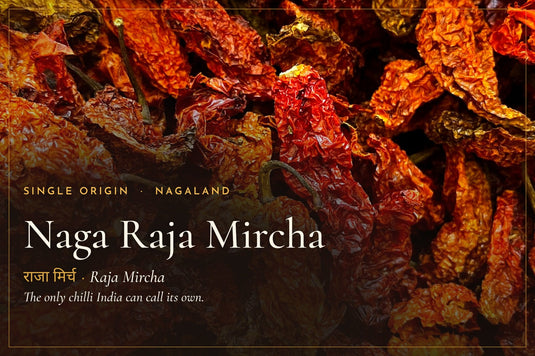
The only chilli India can truly call its own.
Here is something that will change how you think about chillies. Every single chilli in India came from Mexico. Somewhere around 1500 AD, Portuguese traders carried Capsicum seed across the ocean, and it spread through the subcontinent, adapted to local soils, and became the heat behind dishes that now feel timeless. The vindaloo, the Chettinad curry, the Kolhapuri mutton, all of them built on a New World import. Every chilli. Except one.
The exception that rewrote history
Deep in Nagaland, far from the port cities where Portuguese ships docked, a different kind of pepper was already growing. Not brought. Not introduced. Evolved. Naga Raja Mircha, known globally as the Ghost Pepper or Bhut Jolokia, is a naturally occurring interspecific hybrid of Capsicum chinense and Capsicum frutescens. Genetic analysis confirmed what local farmers always knew. This pepper exists nowhere else on Earth. It evolved here, in the rolling hills where tribal communities have cultivated it for generations.
What we call it
Across Nagaland’s hills, different tribal communities have grown Raja Mircha for generations, and each has its own name for the crop. Travel through the Northeast and the name changes with the tongue.
Assamese Bhut Jolokia (भूत जोलोकिया), Bih Jolokia · English Ghost Pepper
Each name carries respect. The Angami call it Chüdi, King of Hotness. The Zeliangrong call it Chaibe-ra-tsi, Leader or Chieftain. In Manipur it is Umorok. The common thread is that this is never just a crop, it is cultural heritage.
And the famous name is a happy accident. “Bhut Jolokia” does not actually mean Ghost Chilli. “Bhut” most likely refers to the Bhutanese traders who once dealt in these peppers along old trade routes, and when Western translators met the word, they confused it with the word for ghost. The mistranslation stuck, and it turned out to be accidentally poetic, because the pepper has a signature trait that makes ghost feel exactly right. Unlike chillies that hit at once, this one waits 15 to 45 seconds. You taste sweetness first, maybe smoke, a hint of fruit, and think it was not so bad. Then the heat arrives, creeping, building, overwhelming. It sneaks up like a ghost. The Assamese have a blunter name that needs no translation at all, Bih Jolokia, Poison Chilli.
When science confirmed what Nagaland already knew
The Chile Pepper Institute at New Mexico State University had been studying this northeastern Indian pepper for years. Their official measurement came back at 1,001,304 Scoville Heat Units. For context, a jalapeño measures about 5,000, and Tabasco sauce about the same. Naga Raja Mircha was 400 times hotter than a jalapeño and 170 times hotter than Tabasco. But here is what most people missed. This was not a pepper engineered for records. It was a pepper that had been quietly building its extraordinary potency over centuries of natural evolution. No lab. No selective breeding. Just the world finally paying attention. In 2007 it became the first chilli ever to officially break a million units, and took the Guinness World Record for the hottest on earth.
The heat comes from capsaicin, present here at 2 to 4 percent against the 0.1 to 0.5 percent of a typical hot pepper. Total capsaicinoids reach around 5.36 percent, roughly 338 times that of a Scotch Bonnet. Independent laboratories have measured it again and again, the Chile Pepper Institute at 1,001,304 SHU in 2005, Frontal Agritech India at 1,041,427 SHU in 2004, and the Defence Research Laboratory at Tezpur at 855,000 SHU in 2004.
To beat the king, they needed the king
After 2007, something interesting happened. Breeders around the world started chasing the record. If nature could create a million unit pepper, surely human intervention could do better. The Carolina Reaper arrived in 2013, bred by Ed Currie in South Carolina. Pepper X followed in 2023. Then Trinidad Scorpion, Dragon’s Breath, Komodo Dragon. And here is the part that gets quietly glossed over. Almost all of them used Naga Raja Mircha genetics as a parent. This is the difference between evolution and engineering. Naga Raja Mircha is the original king, and to beat the natural king, breeders needed the natural king’s DNA. It is irreplaceable. The others are reproducible.
The terroir test, fifty percent heat loss
In 2005, New Mexico State University ran an experiment that should have settled any debate about the importance of origin. They took Naga Jolokia seeds and grew them in Gwalior instead of their native Tezpur in Assam. The result was a fall in heat of more than fifty percent. Same seeds. Different soil and climate. Half the fire. This is not marketing mythology, it is measurable chemistry. Capsaicin, the compound responsible for heat, develops differently with environmental stress, soil composition and growing conditions, and Nagaland’s unique combination cannot be replicated. When you buy a ghost pepper grown elsewhere, you are buying a diminished version. The name may be the same. The pepper is not.
On 2 December 2008, GI Certificate Number 99 made Naga Raja Mircha the first product from Nagaland to ever receive Geographical Indication protection. The same kind of protection that ties Champagne to one French region now ties this pepper to Nagaland, so only chillies grown in the state by local farmers using traditional methods can legally carry the name.
Beyond the kitchen, grenades and elephants
The extreme potency of Naga Raja Mircha drew attention well beyond food. India’s Defence Research and Development Organisation developed military applications, including 81mm chilli grenades for anti terrorist operations, pepper spray for women’s self defence, and smoke bombs that can block night vision devices. Dr R. B. Srivastava of DRDO explained the logic plainly, that the pungent smoke forces a hideout empty and causes choking and streaming eyes, with no lasting harm.
Meanwhile, in and around Kaziranga National Park, a gentler use emerged. Farmers in the Northeast have long used Raja Mircha to keep wild elephants off their crops. Chilli paste on the fences. Dung bombs made from dried elephant dung mixed with ground ghost pepper. The practice has since hardened into formal deterrent systems, the capsaicin catching the thousands of sensitive nerve endings in an elephant’s trunk and turning it away, without any lasting harm to the animal.
The day Gordon Ramsay met his match
The world’s most famous chef was filming in Jorhat, Assam, in April 2009. Someone handed him a Bhut Jolokia. Gordon Ramsay took a bite, screamed that it was too much, and reached desperately for water. Standing next to him was Anandita Dutta Tamuly, a 26 year old homemaker from Titabor. While Ramsay struggled with a single pepper, she ate 51 Ghost Peppers in two minutes, and was disappointed, having managed 60 in 2006. Without tears. Her backstory explains it. At the age of five, her mother applied chilli paste to cure a tongue infection, and from then on she ate Bhut Jolokia with salt every day. While other children looked for berries, she told reporters, she foraged for ghost peppers.
The king does not compete
New superhot peppers emerge every few years. Carolina Reaper. Pepper X. Apollo. The arms race continues, and Naga Raja Mircha does not take part. Not because it cannot, since at over a million units it still belongs to the elite tier, but because competition misses the point. The lab bred challengers are optimised for a single metric, maximum capsaicin, which they reach through deliberate selection while sacrificing everything else. Naga Raja Mircha was optimised by centuries instead. Its heat grew up alongside its flavour, the sweetness, the smokiness, the fruit, a burn that lingers without overwhelming. It grew without synthetic inputs, beside the biodiversity of the hills and the tribal communities who carried it. You can engineer a hotter pepper. You cannot engineer centuries of coevolution between pepper, place and people. You can read the full sourcing and heat detail on the Naga Raja Mircha product page.
A chilli with an address
When you buy authentic, GI certified Naga Raja Mircha, you are getting heat that was earned rather than manufactured, terroir that genuinely matters, complete traceability from Nagaland’s hills to your kitchen, and a living heritage of sixteen tribal communities and traditional jhum cultivation that is organic by default rather than by certificate. Most of all, you are getting the original. Every superhot that came after descends from this pepper. The Carolina Reaper can claim to be the hottest. It cannot claim to be the original. This is the only natural one of its kind, the genetic ancestor of all the engineered heat that followed, and that is the difference between a king and a pretender. We source ours directly from farmers in Dimapur, Nagaland, with full traceability from soil to shelf. Try our Naga Raja Mircha, or browse the rest of the single origin collection.
From Our Shelf