Pantry Notes
The Queen of Spices, from the hills that carry her name.
Every cup of masala chai in India owes its perfume to one small green pod. Cardamom is so woven into the way we cook that we rarely stop to think about where it grows, or that its name has survived almost unchanged from a word spoken in South India thousands of years ago. This is the story of the cardamom from the Cardamom Hills of Idukki, the green pods the old trade called the Queen of Spices, and a range of mountains named after the very crop they carry.
The hills named after the spice
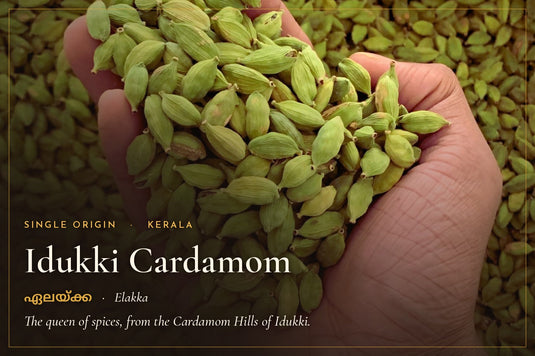
Cardamom grows in the southern stretch of the Western Ghats, in a range so defined by this one crop that it is simply called the Cardamom Hills. Most of it falls inside Idukki district in Kerala, a cool, folded country of forest and mist, and at its heart is the Cardamom Hill Reserve, a little over a thousand square kilometres set aside for the plant. Kerala alone grows close to seventy per cent of all the cardamom in India.
The pods come from the southern slopes between about eight hundred and thirteen hundred metres, near the edge of the Periyar reserve, where the cardamom plant grows in the shade beneath the forest canopy rather than in open sun. The height, the shade and the long monsoon all slow the plant down, and a slow plant fills its seeds with more of the volatile oils that carry the aroma. The cardamom here is hand picked, pod by pod, across a season that runs from autumn into the cold months.
What we call it
The name is one of the oldest in any Indian kitchen. Sanskrit knew the spice as ela, a word itself borrowed from a still older Dravidian root, el, and from that single root almost every Indian name for cardamom still descends.
Telugu Yelakulu · Bengali Elach · Gujarati Elchi · Sanskrit Ela
The Hindi elaichi, the Malayalam elakka, the Tamil elakkai, the Kannada elakki, all of them are the same ancient word worn smooth by centuries. Even the botanical genus, Elettaria, was taken from the Tamil. The word travelled west as well, becoming the English cardamom by way of the Latin cardamomum and the Greek kardamomon. And the Cardamom Hills carry it most plainly of all: in Malayalam they are the Ela Mala, ela the cardamom and mala the hills, a whole mountain range named after a seed.
Cardamom is old enough that a form of its Greek name, written ka-da-mi-ja, appears in Linear B, the script of Bronze Age Greece, more than three thousand years ago. Few spices in any kitchen carry a name that can be traced back so far.
The Queen, the port, and the Travancore kings
If pepper is the King of Spices, cardamom has long been called the Queen, and like pepper it has been traded out of these coasts since antiquity. Large scale cultivation in Kerala only began in the nineteenth century, tended at first by Tamil families settled near the Idukki hills, but it grew valuable fast. By the eighteen fifties the Travancore kings had made cardamom a priority of the realm, holding the trade as a state monopoly and requiring that the spice be sold through a single depot at the port of Alappuzha, known then as Alleppey.
That port left its mark on the name. The grading and drying methods perfected at Alleppey became the benchmark the rest of the world measured cardamom against, and so the spice was registered as a Geographical Indication under the name Alleppey Green Cardamom, after the harbour it shipped from rather than the hills it grew in. It is the same quiet trick of history that named Tellicherry pepper after the port of Thalassery. We call ours Idukki cardamom, after the place it actually comes from.
The variety a farmer bred
Most of the cardamom in these hills today traces back to one man. Sebastian Joseph, a smallholder in the Kattappana hills of Idukki with little more than an acre and a fourth standard schooling, spent years choosing his strongest plants and crossing them by hand, penning bees inside mosquito netting to control the pollination, until he fixed a variety that bore far more and far larger pods than the old local cardamom, around a hundred and twenty to a hundred and sixty capsules on a plant where the ordinary kind gave barely thirty. He named it Njallani, after his ancestral land, and with his son Rejimon multiplied it from cuttings rather than seed.
It changed the hills. Close to nine in every ten acres of cardamom in Idukki now grow Njallani, and when scientists first sequenced the cardamom genome, the plant they chose was a Njallani Green Gold. Ours is this variety. In a typical cured lot around seventy parts in a hundred grade above seven millimetres, the bold pods that hold the most seed and the most oil. The deep green colour is its own quiet test of quality: cardamom keeps that colour only when it is cured promptly and gently, and a pod left too long, or dried too hard, gives itself away by turning brown.
What is inside the pod
Green cardamom, the true cardamom, is Elettaria cardamomum, a tall perennial in the ginger family. The pod itself is a small spindle with three flat sides and a thin, papery shell, and the aroma does not live in the shell but in the cluster of dark, sticky seeds it protects. Crack one open and you understand why the intact pod matters: those seeds hold their scent only while they are sealed inside.
Grade is a matter of size, and the bold grade, the plump eight millimetre pods, carries more seeds and more oil than the small. One bold pod will do the work of two or three lesser ones. The best green cardamom is also unusually rich in oleoresin, the aromatic oil held inside the seed, around seven parts in a hundred, among the richest of any green cardamom, which is simply why a single bruised pod can scent a whole pot. The aroma itself comes from a handful of compounds working together, the cool, eucalyptus freshness of cineole over the sweet, warm, faintly floral note of terpinyl acetate, lifted by a thread of lemon and a coolness close to mint. That balance, cooling and sweet at once, is the signature of true green cardamom.
It is worth saying what this is not. Black cardamom, the large, dark, smoky pod sold as badi elaichi, is a different plant altogether, Amomum subulatum from the Himalayan foothills, and it cannot stand in for the green. The two share a family and a name and very little else.
Why we send it whole, and single origin
Most cardamom is sold as anonymous grade, pods pooled from many gardens and bought by size alone. Ours is one origin, the Cardamom Hills of Idukki, the Njallani Green Gold variety in the bold eight millimetre grade, the cardamom that carries the Geographical Indication. We send it as whole pods rather than loose seeds or powder for a simple reason: the pod is the seed's own packaging. Sealed inside its shell, the aroma keeps for a long time, while ground cardamom and bare seeds lose their lift within weeks.
So you crush or bruise the pod fresh, in the quantity you need, the moment you cook, and what reaches the pan still smells of the hill. You can read the full sourcing and grade detail on the Idukki Green Cardamom product page.
Cooking with Idukki cardamom
Cardamom works two ways. For chai, biryani, pulao and any long, slow pot, bruise a pod or two and drop them in whole, letting the warm sweetness seep through the dish; the spent pods are lifted out at the end or simply left aside on the plate. For sweets, the seeds are crushed to a fine powder and folded in at the close of cooking, into payasam and kheer, halwa and ladoo, where their perfume is the whole point. A little carries a long way, so begin with less than you think.
It sits naturally beside the rest of a warm spice shelf, clove, cinnamon, pepper and saffron, and it crosses borders easily. In the Gulf, cardamom and coffee are roasted and pounded together into gahwa, a coffee that can run to as much as forty parts cardamom in a hundred.
A spice with an address
Most cardamom is anonymous, graded by the millimetre and sold by the sack. This one has an address, the misty Cardamom Hills of Idukki, a range named after the pod itself. Bruise one into your next pot of chai and you will taste the difference between cardamom in general and a cardamom from somewhere. Try our Idukki Green Cardamom, or browse the rest of the single origin collection.
From Our Shelf