Pantry Notes
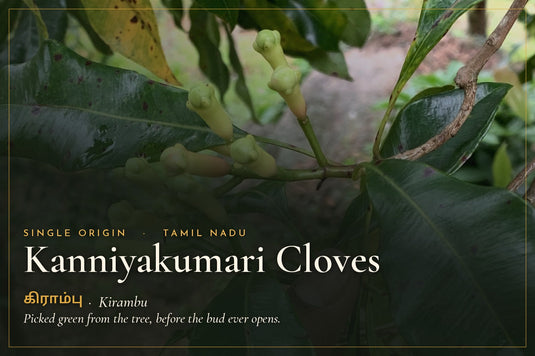
A Spice Island bud, at home on the twin monsoon hills at the tip of India.
There is a clove in almost every Indian kitchen, in the biryani, the garam masala, the cup of spiced tea at the end of a meal. Yet hardly any of it is local. The clove is one of the great travellers of the spice world, a bud that grew on a handful of volcanic islands and was fought over for centuries before it ever reached an Indian field. This is the story of how it got here, and why the cloves grown at the very tip of India hold more of their famous oil than almost any other.
The hills at the end of India
Kanniyakumari is the last district of mainland India, the place where the Western Ghats run down to meet three seas. Clove grows high in its reserve forests, in the densely wooded Maramalai, Blackrock and Velimalai ranges inside the Veerapuli Reserve, and on the slopes of Mahendragiri. This one small district grows close to sixty five percent of all the cloves in India, and Tamil Nadu as a whole accounts for around three quarters of the country's clove land.
What sets the place apart is its weather. Kanniyakumari sits where both the south west and the north east monsoon arrive, so the hills stay watered through much of the year, over deep, humus rich forest soil. The buds are dried slowly on the plantations, at around eight hundred metres, where the air is moderate rather than fierce. Less of the fragile oil escapes in that slow, cool drying, which is the simple reason these cloves carry about twenty one percent volatile oil, against the roughly eighteen percent that Indian cloves average.
A clove's whole character is its oil, and Kanniyakumari buds run to about twenty one percent of it, among the highest of any Indian clove. Nearly all of that oil is a single compound, eugenol, which makes up close to eighty six percent of it. More oil in the bud means more of the warm, sweet scent the moment you crush one.
What we call it
The English word clove comes from the Latin clavus, meaning a nail, because a dried bud, with its slender stalk and rounded head, looks exactly like a small iron nail. Across India the spice carries older names of its own.
Kannada Lavanga · Bengali Lobongo · Sanskrit Lavanga
Most of these names trace back to the Sanskrit lavanga, the word that travelled with the spice across the subcontinent. In the Tamil of Kanniyakumari it becomes kirambu, the name you will hear in the markets nearest the hills where it grows.
How a Spice Island bud reached India
The clove is the dried, unopened flower bud of an evergreen tree, Syzygium aromaticum, and for most of history it grew in only one place on earth, a cluster of small volcanic islands in the Maluku group of eastern Indonesia, the original Spice Islands. For a long time the rest of the world had the spice without ever knowing where it came from.
It was prized very early. In the Han court of China, more than two thousand years ago, officials were expected to hold cloves in the mouth to sweeten the breath before addressing the emperor, which is how the spice earned the old Chinese name of chicken tongue spice. By the Middle Ages it was worth more than its weight in gold in the markets of Europe, and the question of who controlled it shaped centuries of trade.
When the Dutch East India Company took the Spice Islands, it guarded the clove fiercely, confining the trees to a single island and sending out expeditions to destroy any that grew elsewhere, so that the price could be held high. The monopoly was finally broken by a Frenchman, Pierre Poivre, who smuggled clove seedlings out in 1770 and carried them to Mauritius and Reunion, and from there the tree spread to Zanzibar, which in time became the largest grower of all.
India came to the clove late. The East India Company is recorded as introducing the tree around 1800, at a spice garden in Courtallam in what is now the Tenkasi country, and from there it spread into the neighbouring reserve forests of Kanniyakumari, where the wet, wooded hills suited it perfectly. Two centuries on, that one district grows most of the cloves in the country.
Zanzibar guarded its cloves as jealously as the Dutch once had. Smuggling a single seedling off the island was, for a time, an offence punishable by death, a law that stayed on the books until well into the twentieth century. The spice that began on a few Indonesian islands is now grown in a thin band of the tropics, and a clove's smell still depends on exactly which of those places it came from.
What is inside the bud
A clove's scent is almost all one molecule. Eugenol makes up close to eighty six percent of the volatile oil, and it is the source of that warm, sweet, faintly numbing note you get the instant a bud is crushed. The rounded head at the top of the clove is the unopened flower, and it holds most of the oil, which is why a clove with its head still attached, rather than a bare broken stalk, is the one with the aroma. Pick the bud too late, after the flower has opened, and much of that oil is already gone.
That numbing quality is not only a kitchen impression. Clove's best known use outside cooking is in dentistry, where oil of cloves, rich in eugenol, has been applied to dull the ache of a bad tooth for centuries, and eugenol still goes into the temporary cements a dentist uses today. It is the same compound either way, the one you smell when you grind a bud for a masala.
Why we send it whole, from one place
Ground clove fades fast. Grinding opens every surface of the bud to the air, and the volatile oil that makes clove worth buying begins to leave at once, so a tin of clove powder is often half gone in scent before it is opened. A whole bud keeps its oil sealed in until the moment you crush it.
So we send it whole, and we send it from a single place. These are Kanniyakumari cloves, grown in the reserve forest hills at the tip of the Western Ghats and registered as a Geographical Indication by the Government of India, as Kanyakumari Clove. They are not pooled from many growing areas, and nothing is stripped out or added. You can read the full sourcing and grade detail on the Kanniyakumari Cloves product page.
Cooking with cloves
Used whole, the bud is built for tempering. Drop two or three into hot ghee or oil at the start of a biryani, a pulao or a meat curry, and let them swell and perfume the fat before anything else goes in. A few whole cloves dropped into a rasam, a stock or a jar of pickle will steep slowly and lift the whole pot without taking it over.
Ground fresh, a single pinch of real clove does the work of a spoonful of a tired one, in a garam masala, a chai masala, or in cakes, mulled wine and spiced syrups, where its warmth carries a long way. It sits naturally beside the rest of a South Indian sweet spice shelf, cardamom, black pepper, nutmeg and cinnamon, the spices it shares a festival kitchen with.
A bud with an address
Most clove is anonymous, a handful of dark buds with no place attached. This one has an address, a single district at the very tip of India that grows most of the country's cloves, on hills wet enough and slow drying enough to leave more oil in the bud than almost anywhere else. Crush one fresh and you will smell the difference. Try our Kanniyakumari Cloves, or browse the rest of the single origin collection.
From Our Shelf