Pantry Notes
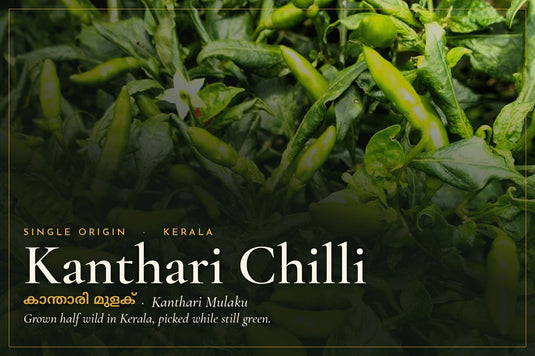
The little chilli that birds plant, picked green from Kerala's gardens.
In a Kerala backyard, the hottest thing growing is often the smallest. The kanthari is a pod barely the size of a fingernail, fierce enough to carry a whole pot of buttermilk, and half the time nobody planted it. Birds did. This is the story of that little chilli, the bird's eye of the Western Ghats, picked and dried while still green, and why a chilli this small has a character this large.
Where Kerala meets Karnataka
Kanthari grows along the border country where Kerala runs into Karnataka, in the Wayanad and Kodagu hills that sit on the edge of the Nagarhole tiger reserve, deep in the Western Ghats. This is high, wet, forested land, with humid air, a long monsoon, and the slightly acidic, humus rich soil this chilli likes. It is hill country rather than open plain, and the chilli grows the way the hills do, a little wild.
It is not a field crop here. Kanthari lives in homestead gardens and in the clearings at the forest edge, a perennial plant that springs up often without anyone planting it, and bears for years from the same root. That half wild way of growing, in this one belt of country beside the reserve, is a large part of why the chilli has the sharp, clean, fruity heat it does.
What we call it
In Malayalam it is kanthari mulaku, the little bird's eye chilli that every old Kerala kitchen keeps. The name changes as you cross the south.
Hindi Chidiya ki Aankh Mirch · English Bird's Eye Chilli
The Hindi name says it plainly, chidiya ki aankh, the bird's eye. And kanthari is its own kind of bird's eye. It is the South Indian one, a cultivar of Capsicum frutescens, the same species as the African bird's eye or piri piri, and a different species from the Thai bird's eye, which is Capsicum annuum. They look alike and they are all fiercely hot, but kanthari is its own variety, shaped by Kerala's climate and its backyard gardens.
How a New World chilli reached Kerala
Chilli is not Indian by birth. It is American. Wild capsicums first grew in South America, and people there were cultivating them thousands of years ago. It reached India only after Vasco da Gama opened the sea route to the Malabar Coast in 1498, and the Portuguese made Goa their base in 1510, carrying chilli seed from their colony in Brazil. Before it arrived, the heat in Indian food came from black pepper and from pippali, the long pepper.
The little bird's eye chillies travelled fast and far. Carried first by Portuguese trade in the sixteenth century and then, as ever, by birds, they took root across Africa and Asia. In Kerala the bird's eye settled into the homestead garden and the forest edge and became the kanthari, the fiery backyard chilli that has been part of the cooking for centuries.
Chillies did not evolve their heat for us. Capsaicin, the compound that burns, registers on mammals but not on birds, whose mouths simply do not feel it. So a chilli gets its seed carried far and wide by the birds that eat the fruit freely and pass the seed unharmed. The kanthari is a textbook case, springing up half wild across Kerala's gardens from seed the birds have sown. The chilli that birds named is also the chilli that birds plant.
What is inside the pod
Two things make a kanthari worth talking about, its heat and the fruitiness underneath it. The heat is capsaicin, which sits mostly in the seeds and the pale inner membrane rather than the flesh, and is measured on the Scoville scale. Kanthari is a true bird's eye, somewhere around fifty thousand to one hundred thousand units, roughly ten to twenty times a jalapeno and close to a mild habanero, all in a pod barely two centimetres long. Yet it is not only fire. There is a clear, almost citrus fruitiness under the burn, which is what marks a good kanthari out from a chilli that is merely hot.
The other thing that sets ours apart is the colour, or rather the lack of red. A kanthari pod is green as it grows and turns bright red only when fully ripe, and most dried chilli on a shelf is the ripe red kind. We pick and dry it green, before it reddens, which keeps a sharper, grassier, fresher character, closer to a fresh green chilli than to a deep red one.
With a bird's eye chilli, smaller really does tend to mean hotter. The heat lives in the seeds and the membrane, and a tiny pod holds more of both for its size than a large one does. So the kanthari, one of the smallest chillies in any Indian kitchen, is also one of the fiercest, which is exactly why a single crushed pod can season a whole pot.
Why we send it green, whole, and single origin
Most chilli on a shop shelf is blended and red. Pods from many lots and growing areas are pooled together, so the heat and the colour drift from one packet to the next. Ours does not work that way. It is one chilli, the kanthari, from the homestead gardens along the Kerala and Karnataka border near Nagarhole, sun dried and picked green, and traced to that one stretch of country rather than pooled from many.
We send it as whole pods rather than powder. Whole, the little pods hold their heat and aroma far longer, and you crush or grind small amounts as you need them, or drop them in whole for a tempering. A little goes a long way, so a small pack lasts. You can read the full sourcing detail on the Kanthari Bird's Eye Chilli product page.
Cooking with kanthari
A little goes a long way, so start with less than you think. In Kerala, kanthari is most often crushed, a pod or two pounded with shallots and salt into thick buttermilk, a coconut chutney, or a fiery chammanthi that wakes up a plate of rice. Whole, the pods go into hot coconut oil with mustard seed and curry leaf at the start of a thoran or a fish curry, lending a sharp heat to everything that follows.
Ground or steeped, kanthari gives a bright, fruity heat to green chilli powders, pickles, hot sauces, and infused oils. It sits naturally alongside the rest of a South Indian shelf, coconut, curry leaf, black pepper, and mustard. One word of care, the oils are strong, so wash your hands well after handling the pods.
A chilli the birds chose
Most chilli is anonymous. This one has an address, a single wild variety from a single stretch of hill country, sown as much by birds as by hand, and dried green the way Kerala has always kept it. Crush one pod and you will taste the difference between chilli in general and a chilli from somewhere. Try our Kanthari Bird's Eye Chilli, or browse the rest of the single origin collection.
From Our Shelf