Pantry Notes
A ginger with its own name, its own species, and a hill range to itself.
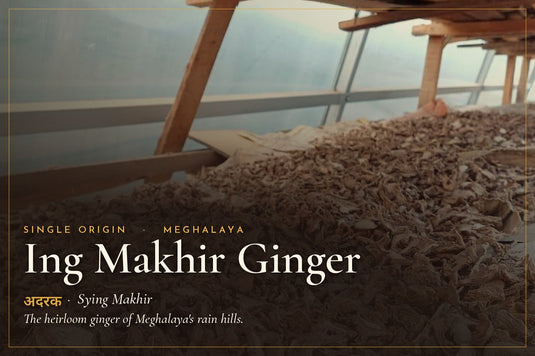
Almost every Indian kitchen keeps ginger, and almost no one asks where it came from. Most of it is a blend, pooled from many farms and grown for the weight it puts on the scale. This is the story of a different ginger, one the Khasi people of Meghalaya call Sying Makhir, the small ginger, grown in the rain hills of the northeast for its flavour rather than its yield, and carrying a name, a species, and a place all its own.
The rain hills that grow it
Meghalaya means the abode of the clouds, and it earns the name. The state holds some of the wettest places on earth, where the monsoon arrives in months-long sheets and the forest never quite dries out. Ing Makhir grows in that rain, in the West Jaintia Hills, in shaded plots roughly six hundred to fifteen hundred metres up, in villages along the Assam border such as Sahsniang and Khatkasla, tended by Khasi and Jaintia farmers in acidic hill soil under a forest canopy.
It is an heirloom variety, grown from seed and rhizome handed down the generations, the traditional way, without chemical fertilisers or pesticides. The plant is smaller and more fibrous than common ginger, which is exactly what suits it to drying and grinding rather than selling fresh. The state's own Ginger Mission is now pushing high yield hybrids to lift production, and against that tide this old ginger survives for one reason: its growers keep it for flavour and strength, not for the weight it puts on the scale.
Meghalaya holds the two wettest inhabited places on earth, Mawsynram and nearby Cherrapunji, where the year's rainfall is counted in metres rather than millimetres. It is this relentless monsoon, soaking acidic hill soil beneath a forest canopy, that the Jaintia Hills ginger is grown in, and terroir like that leaves its mark on a spice.
What we call it
In Khasi, ginger is sying, and this variety is Sying Makhir, also written Ing Makhir. Travel across India and the word for ginger changes with the language.
Telugu Allam · Kannada Shunti · Bengali Ada · Marathi Aale · Gujarati Aadu
The name itself is plain and affectionate. Sying is ginger and makhir is small, so Sying Makhir is simply the small ginger, named for the size of its rhizome. There is one more layer worth knowing. Dried ginger so often carries its own separate name in Indian kitchens: the fresh root is adrak in Hindi, but once it is dried it becomes sonth, and it is inji in Tamil and Malayalam fresh but sukku or chukku once dried. This ginger, dried and milled, belongs to that older, quieter half of the spice shelf.
A ginger that is its own species
The ginger most of the world cooks with is Zingiber officinale, grown across the tropics in great quantity. Ing Makhir is not that plant. Botanically it is Zingiber rubens, a different species, an indigenous ginger of the northeastern hills rather than a commercial variety bred for the market.
Being smaller, more fibrous and lower yielding, it was never going to win on volume, and across India most such native gingers were quietly abandoned for high yield hybrids. Ing Makhir survived because hill communities kept growing it for its flavour and for their own kitchens. When Meghalaya launched its Ginger Mission to lift production, it reached for improved varieties like IISR Mahima, Varada and Nadia. Against all of that, this heirloom holds on as one of the last indigenous gingers still grown in India, a plant kept alive by taste and habit rather than by economics.
What is inside it
Two things give ginger its character, its warmth and its aroma, and both trace back largely to one family of compounds. Gingerol is the main one, the pungent compound that gives ginger its bite, and the more of it a ginger carries, the more pungent and aromatic it is. Ing Makhir is unusually rich in it, around 1.97 percent against the 0.1 to 1 percent typical of common ginger, alongside a high content of the volatile oils that carry its smell. That is the simple chemistry behind why a little of it tastes of so much.
A peer-reviewed study of Zingiber rubens published in 2025, in the Proceedings of the Indian National Science Academy by Sarder Sabrina Zaman and Highland Kayang, set out the most detailed profile of this ginger so far. It reported the rhizomes rich in phenolics, flavonoids and other bioactive compounds, with antioxidant, antimicrobial and anti-inflammatory activity measured in the lab, and roughly two to three times the gingerol and nearly three times the volatile oil of common ginger.
None of that was news to the hills. Long before any of it was measured, Khasi and Jaintia households were already using this ginger in their cooking and in their monsoon-season remedies, and in Ayurveda ginger has always been valued for warmth and for the digestion. The laboratory is simply catching up with the kitchen.
Why we send it single origin and ground
Most ginger powder on a shelf is blended, pooled from many farms and varieties so that no one lot stands out and nothing is traceable. Ours is the opposite. It is one variety, Zingiber rubens, from the West Jaintia Hills, grown the traditional way without chemical inputs and never cut with cheaper ginger to stretch it.
It is harvested between December and February, when the rhizome's oils are at their fullest, then washed, sliced and dried until it will grind cleanly and keep, and milled to a fine powder on its own and sealed, so its aroma is held in until you open it. You can read the full sourcing detail on the Ing Makhir ginger powder product page.
Cooking with Ing Makhir
Because it is so concentrated, a little goes a long way, so start small. A quarter teaspoon stirred into a pot of chai gives a brew that actually tastes of ginger, warm and clean with a citrus edge. The same small measure lifts curries, dals, marinades and spice mixes, carrying more aroma and warmth than an ordinary ginger powder would.
Whisked into hot water with lemon and a little honey, it makes the simple ginger drink Indian kitchens have always reached for in the cold and the rain, and a pinch alongside turmeric turns a glass of golden milk properly warming. It sits naturally beside the rest of a warm spice shelf, cardamom, black pepper and turmeric among them.
A ginger with an address
Most ginger is anonymous, a beige powder from nowhere in particular. This one has an address, a single heirloom variety from a single range of rain-soaked hills, kept alive by the people who have always grown it. Stir a little into your next pot of chai and you will taste the difference between ginger in general and a ginger from somewhere. Try our Ing Makhir ginger powder, or browse the rest of the single origin collection.
From Our Shelf