Pantry Notes
Born in the Banda Islands, grown in the hills of Travancore.
In the spice box, nutmeg is the warm one. It is the sweet, woody note in a Christmas cake, the grating over a bowl of mashed potato, the dusting on a milky coffee. What few of us think about while grating it is how far it has come. Nutmeg is not Indian, and it is not European. It began on a cluster of tiny volcanic islands in the Banda Sea, was once worth more than its weight in gold, and reached the hills of Travancore by way of one of the longest and bloodiest trade stories there is. This is the story of that spice, and of the Kerala country where India now grows its own.
Where India grows its nutmeg
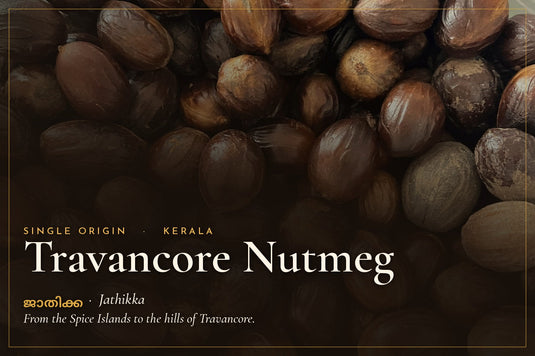
Our nutmeg comes from Central Travancore, the Kottayam and Pathanamthitta country of central Kerala, where the land folds up into the foothills of the Western Ghats. It is hot, wet, humid ground, soaked by a long monsoon, and that is exactly the air a nutmeg tree wants. Here it grows on small farms and garden plots, in the half shade between the pepper vines and the coffee, the way so many of Kerala's spices do.
Nutmeg has been grown in this part of Kerala long enough to feel native, but it is not. It is a guest that settled in and made itself at home, and to understand how it got here you have to cross the Bay of Bengal and go back a few hundred years, to a sea on the far side of Indonesia.
What we call it
Across India nutmeg goes by names that nearly all trace back to one Sanskrit root, jatiphala. In Kerala it is jathikka, or simply jathi, the seed of the jathi tree. Travel north and it becomes jaiphal. The mace, the red lace around the seed, carries its own names.
Kannada Jaikai · Marathi Jaiphal · Sanskrit Jatiphala · English Nutmeg
The mace Javitri (Hindi), Jathipathri (Malayalam), Mace (English)
Two names, then, for two spices that share a single fruit, which is where the story of nutmeg itself begins.
The spice worth more than gold
For most of its history, nutmeg grew in exactly one place on earth. The Banda Islands, a scatter of small volcanic islands in the Moluccas of eastern Indonesia, the original Spice Islands, were the only place the tree was found. That single fact made nutmeg one of the most valuable things in the world. By the time it reached Europe, traded hand to hand across oceans, it was worth more than its weight in gold, was believed to ward off the plague, and whole nations went to war for control of it.
The Portuguese reached Banda in 1512 and took the trade. In the seventeenth century the Dutch East India Company seized it and held on with extraordinary cruelty, even cutting down nutmeg trees grown anywhere they did not control, to keep the spice scarce and the price high. The French finally smuggled seedlings out in 1772, the British broke the monopoly in 1802, and from there the tree was carried across the tropics: to Grenada, which loved it enough to put a nutmeg on its national flag, to Sri Lanka, and to the humid Western Ghats of Kerala, where ours grows today.
One nutmeg island wrote itself into the map of the modern world. In 1667, after years of fighting, the English and the Dutch signed the Treaty of Breda. The English gave up their claim to Run, a tiny nutmeg island in the Banda group, and kept in exchange a far off island the Dutch had been holding, called Manhattan. New York, in a sense, was traded for nutmeg.
Two spices from one fruit
A nutmeg fruit looks a little like a small, pale apricot, yellow and smooth, and when it ripens it splits cleanly along a seam. Inside is not one spice but two, wrapped together. The hard brown seed at the centre is nutmeg. The scarlet, lacy web clasped around that seed is mace, peeled away and dried as a spice in its own right.
They taste like relatives rather than twins. Nutmeg is warm, sweet and woody. Mace is lighter and brighter, with more of a citrus edge, and cooks reach for it in pale dishes and fine sauces where nutmeg's deeper colour and flavour would be too much. In India mace is javitri or jathipathri. This story, and our pouch, is about the seed, the nutmeg itself.
How it is grown and dried
The nutmeg tree is in no hurry. A tree begins to bear fruit only around its sixth year, and does not reach its full yield until it is about twenty. After that it can go on fruiting for decades. The fruit takes its time too, roughly nine months from flower to harvest, with the main season falling in June to August, and it is ready only when the pericarp cracks open of its own accord.
From there the work is careful and done by hand. The fleshy fruit is removed, the red mace is peeled from the seed, and the two are dried separately in the sun. The scarlet mace slowly fades to a brittle yellow brown, while the nut, much slower to dry, is left until the kernel inside rattles. Only then is it milled. Dry it well and keep it whole until grinding, and the oil that holds all the aroma stays locked inside.
At the table, a pinch is plenty
Nutmeg lives a double life in the kitchen. In sweet cooking it is everywhere, in cakes and custards and rice puddings, in apple pie spice, in the warm blends that flavour the cold months. On the savoury side it is the quiet secret in a good bechamel, a grating over mashed potato or buttered spinach, a small note in a garam masala. And it belongs to warm drinks, dusted over coffee and chai, into eggnog and mulled wine. In Indian kitchens it leans mostly to the sweet side, and into the spice tin.
However you use it, use a little. Nutmeg is one of the most concentrated spices there is, and an eighth of a teaspoon is enough to scent a whole cup of sauce. It is a spice of restraint, added near the end of cooking so its aroma is not driven off, and because so little is needed, a small pack lasts a remarkably long time.
Why we keep it single origin
Most nutmeg sold is blended bulk, pooled from many origins and varieties and ground together. The trouble with that is the oleoresin, the oil that carries nutmeg's whole character. Blend many lots and you average it down. Keep to one origin, grown and dried for that oil, and you keep the potency. Our Travancore nutmeg runs about 6.24% essential oil at around 8% moisture, the marks of a well dried, oil rich nut, with nothing added to stretch it.
That is what single origin means for us, one fruit from one stretch of Kerala hill country, traced and milled as it is. You can read the full sourcing detail on the Travancore Nutmeg product page.
Nutmeg's aroma is not in the brown of the seed but in the oil hidden inside it. That oil, and the wider oleoresin around it, is what your nose meets the moment a nutmeg is grated. It is also fragile, fading once the seed is ground, which is why fresh, well dried, oil rich nutmeg from a single source tastes so much rounder and warmer than the average tin of pre ground powder.
The spice with a map behind it
Grate a little nutmeg into a pot and you are using a spice with a five hundred year map behind it, from a handful of islands in the Banda Sea to the misty hills of the Western Ghats. Most nutmeg on a shelf has lost that story to the blend. Ours still carries its address, Travancore, the corner of Kerala where India grows its own. Try our Travancore Nutmeg, or browse the rest of the single origin collection.
From Our Shelf