Pantry Notes
Coorg's dark, sour vinegar, simmered from a wild monsoon fruit.
In a Coorg kitchen, the bottle that matters most is often the smallest and the darkest. It holds kachampuli, a vinegar that almost no one outside Kodagu has tasted, made not from grapes or cane but from a wild forest fruit, gathered in the monsoon and simmered down to a thick, sour, near black concentrate. This is the story of that vinegar, the souring soul of the Kodava table, and of the fruit it comes from.
Where Coorg meets the monsoon
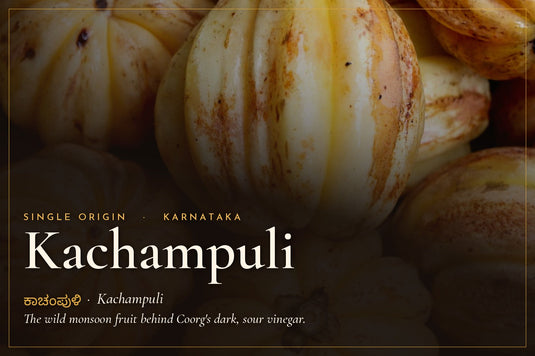
Kachampuli comes from Kodagu, the hill district of Coorg in Karnataka, the green, misty highland that gets called the Scotland of India. It sits in the Western Ghats, and the fruit it is made from, Garcinia gummi-gutta, grows wild there, in the evergreen and shola forests and in the shade of the old coffee estates. The fruit is a small, ribbed, sour gourd, green on the branch and ripening to a soft yellow.
It is a creature of the monsoon. The tree flowers in the dry months and fruits from June to August, in the heart of the rains, and that is the season when Kodava families make their year's kachampuli. The making is not an industry but a household rhythm, foraged and handed down, tied to the wet months the way the coffee harvest is tied to the dry ones. We source ours near Kutta, a village in south Kodagu at the forest edge.
What we call it
In the Kodava tongue the fruit is panapuli and the dark extract boiled from it is kachampuli. Cross into Kerala and the very same fruit, dried instead of boiled, becomes kudampuli, the fish tamarind of a Malabar fish curry. The names multiply as you travel.
Tamil Gorakkapuli · Telugu Kodampuli · Hindi Goraka, Vilaiti Imli · Sanskrit Vrikshamla
English Malabar Tamarind, Fish Tamarind, Brindleberry
Behind all the names is one fruit and one family. Garcinia gummi-gutta belongs to the same genus as the mangosteen and as kokum, and the English label people reach for, Malabar tamarind, is a little misleading, because it is not a tamarind at all. Tamarind is the pod of a legume tree. This is a Garcinia, and the sourness, the colour, and the way it behaves in a pot are all its own.
One fruit, three sour things
India sours its food in many ways, and three of the best known all come from the Garcinia family, those mangosteen cousins of the Western Ghats and the coasts. It is worth telling them apart. Kokum is Garcinia indica, dried to a dark purple rind and used along the Konkan coast, in sol kadhi and in Mangalorean and Maharashtrian cooking. Kudampuli is Garcinia gummi-gutta, the same fruit as ours, sun dried whole and lightly smoked, the souring agent that gives a Kerala meen curry its tang.
Kachampuli is the third way, and the rarest. Coorg takes that same gummi-gutta fruit and, instead of drying it, lets it break down and boils the juice down to a vinegar. One family, three sour things, three regions, three methods. Kerala dries the fruit, Konkan dries its cousin, and Coorg alone decocts it into this dark, concentrated liquid.
Kachampuli is old. The fruit appears in a nineteenth century edict of Lingarajendra II, a king of Coorg, and the vinegar made from it is listed today on the Slow Food Ark of Taste, the international register of heritage foods at risk of being lost. It is not a new product chasing a trend. It is a living tradition that Coorg has kept going through the monsoons, one clay pot at a time.
How it is made
Making kachampuli is slow, and it begins with waiting. The ripe fruit is gathered and heaped up in baskets and left, so that over a few days it breaks down on its own and the juice runs out and is collected in earthen pots. That juice is then simmered, gently and for a long time, in a deep clay pot, deep because as it cooks down it foams and rises. Slowly it reduces and thickens, until what began as a potful of thin juice becomes a small quantity of dark, heavy concentrate.
Nothing is added. No colour, no sugar, no preservative. The acidity and the long reduction are what keep it, and keep it remarkably well, five to six years in the bottle and often longer. Every Coorg home keeps a bottle at the ready, and a good one only seems to improve with age.
Watch kachampuli being made and you watch it change colour. The fresh juice runs honey yellow, then as it simmers and reduces it turns through purplish pink to a deep purple red, and at last to the near black of the finished vinegar. The colour is the clock. A Coorg cook reads how far the reduction has gone, and when to stop, by the shade in the pot.
The Kodava table, and Pandi Curry
Kachampuli is the signature of Kodava cooking, and nowhere more than in pandi curry, the Coorg pork curry that is the pride of the region. The deep brown black colour of a good pandi curry and its sour edge both come from this one ingredient. It goes in late, a spoonful stirred into the finished pot, where it sours the gravy, helps soften the meat, and turns the curry dark. You do not taste it on its own. You taste it as the thing that makes the dish taste like Coorg.
A little does a great deal, so it is used with a light hand, the old measure being about half a teaspoon to a kilo of meat, added at the end rather than cooked from the start. Beyond pork it sours fish and vegetable dishes too, anywhere you might otherwise reach for tamarind or lime, though it brings a depth and a dark colour those do not. If you ever run short, dried kudampuli soaked in hot water is the closest stand in, since it is the same fruit.
Why we bottle it single origin, and whole
Most of what a shelf calls vinegar is brewed and standardised to a fixed strength and a uniform taste. Kachampuli is the opposite. It is the reduced juice of one wild fruit, from one stretch of forest country near Kutta, made the slow way Kodava families have always made it, with nothing added to stretch it or colour it. Because it is a true concentrate, a very little goes a long way, and a single bottle lasts for years.
That is what single origin means here. Not a blend pooled from many places, but one fruit from one forest, traced and bottled as it is. You can read the full sourcing detail on the Kachampuli, Malabar Tamarind Vinegar product page.
The vinegar with an address
Most vinegar is anonymous. This one has an address, a single wild fruit from a single corner of the Western Ghats, gathered in the monsoon and simmered down the way Coorg has always done it. Add a spoonful to a pot of pork and you taste the difference between vinegar in general and a vinegar from somewhere. Try our Kachampuli, the Malabar Tamarind Vinegar of Coorg, or browse the rest of the single origin collection.
From Our Shelf