Pantry Notes
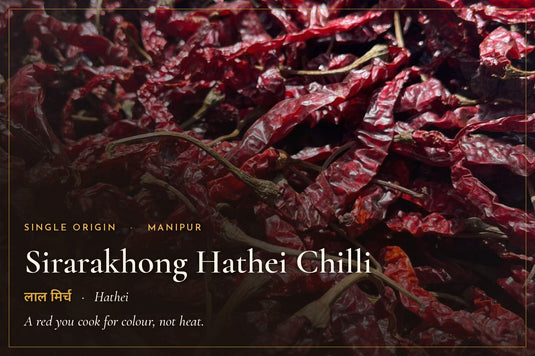
One village, one chilli, a red you cook for colour, not heat.
In most of India, a red chilli is grown for its bite. In one cluster of villages in the hills of Manipur, it is grown for its colour. The Sirarakhong Hathei is gentle enough to use by the handful, and so deeply red that, come harvest, the slopes above the village look as though a red cloth has been thrown across them. For generations almost none of it left the state. This is the story of that chilli, the place that made it, and why colour, not heat, is the whole point.
Where the hills turn red
Sirarakhong is a village in Ukhrul district, in the far east of Manipur, about sixty six kilometres from the state capital at Imphal, in the homeland of the Tangkhul Naga. The chilli takes its first name from the village and its second, Hathei, from the Tangkhul word for the crop. It is grown the old way, on hill slopes cleared by jhum, the shifting cultivation that has shaped these uplands for centuries.
What the village has, and what a grower cannot pack into a sack and carry away, is the particular meeting of soil, altitude and mist in this one pocket of the hills. Plant the same seed on flatter, warmer ground and the colour fades. That is the heart of terroir, and it is exactly the reason the chilli now carries a Geographical Indication tied to this place and no other. The crop is small. Roughly four hundred households grow it, the yearly harvest is only around twenty to twenty five tonnes, and close to all of it is eaten within Manipur.
What we call it
In the Tangkhul language the chilli is Hathei, a single word that carries the place with it. Cross a few borders and the word for chilli changes with every one.
Bengali শুকনো লঙ্কা (Shukno Lanka) · Tamil மிளகாய் (Milagai) · Telugu ఎండు మిర్చి (Endu Mirchi) · Malayalam ഉണക്കമുളക് (Unakka Mulaku)
Locals also speak of the crop simply as the red of the hills, and in Manipuri, the language of the valley, chilli is morok. The Tangkhul name Hathei is often read as carrying a sense of the sharp or the pungent, the small catch at the back of the throat that even a mild chilli leaves behind.
How a New World fruit reached the Naga hills
Chilli is not Indian by birth. It is American. Wild capsicums first grew in the Americas, where people were cultivating them thousands of years ago, and the fruit reached India only after the Portuguese opened the sea route and carried chilli seed to Goa in the early fifteen hundreds. Before it arrived, the heat in Indian food came from black pepper and from long pepper. The newcomer spread inland over the centuries that followed, and in time it climbed into the far Northeast.
In the Tangkhul villages around Sirarakhong, families took the new fruit and made it their own, saving seed season after season from the plants that did best in their narrow band of soil and weather. Generations of that quiet selection produced a chilli unlike any grown elsewhere, mild, aromatic and extraordinarily red. Long invisible to the wider market, it was finally recognised when the Government of India awarded it a Geographical Indication in 2021, in the same round as Manipur's Tamenglong orange.
Sirarakhong's harvest is tiny, only around twenty to twenty five tonnes a year, and close to ninety five percent of it is eaten within Manipur, partly because the hill terrain and the roads make moving it out difficult. Since 2010 the growers have marked the crop with the Sirarakhong Hathei Phanit, an annual chilli festival where the first red pods are blessed and the year's harvest is celebrated, with the women who tend the fields at its centre.
What is inside the pod
Two things define a chilli, its colour and its heat, and Sirarakhong is almost all colour. The red comes from a family of carotenoid pigments, chiefly capsanthin and capsorubin, which build up as the pod ripens fully on the plant. The more completely a chilli reddens, the more of these pigments it holds, and Hathei is picked only when it is deeply, evenly red.
Heat is a separate compound altogether, capsaicin, and this chilli carries very little of it. That is the unusual thing about Sirarakhong, a brilliant, lasting red with only a soft, aromatic warmth behind it. It is the opposite of a ghost chilli, where the burn is the whole story. This is a colour and aroma chilli, not a fierce one, which is why a cook who shies away from heat can still use it freely.
A chilli's red is graded in the laboratory as its ASTA colour value, a measure of the extractable red pigment in the pod. A common dried red chilli might read around one hundred and twenty. Sirarakhong Hathei has been measured between 150 and 165, with one assessment at 164. That is why a small pinch tints a whole pot, and why so little heat travels with the colour.
Why we send it single origin, sun dried, and whole
Most dried chilli on a shelf is blended. Pods from many lots and growing areas are pooled, so the colour and the heat drift from one packet to the next. Ours does not work that way. It is one chilli from one village, grown by Tangkhul families on their jhum plots, registered as a Geographical Indication.
It is harvested by hand when fully red, sun dried in the open, cleaned, and sent as whole pods rather than powder. Whole, it keeps its colour and aroma far longer, and you grind it fresh in the amount you need, so what reaches your pan still smells of the field. Because so little is grown and so little ever leaves the state, every batch is genuinely seasonal. You can read the full sourcing and grade detail on the Sirarakhong Hathei Chilli product page.
Cooking with Sirarakhong Hathei
This is the chilli to reach for when you want a deep red and a gentle warmth rather than a fierce one. Used whole, slip two or three pods into hot oil or ghee at the start of a dish and let them bloom for a few seconds; they release colour and a soft, fruity aroma without setting the dish alight.
Ground fresh, it behaves like a natural paprika, a colour first powder for gravies, marinades and tandoori style rubs where you want the redness of a Kashmiri or Byadgi chilli with even less heat. Soaked and blended into a paste, it lends body and a clean red to a curry base or a chutney. It sits easily beside the rest of an Indian shelf, turmeric, ginger, and the hotter chillies you can now add by choice rather than by default.
A chilli grown for its colour
Most chilli is bought to burn. This one is grown to glow, a single landrace from a single village in the Manipur hills, mild enough to use by the handful and red enough to colour a whole pot. Try our Sirarakhong Hathei Chilli, or browse the rest of the single origin collection.
From Our Shelf