Pantry Notes
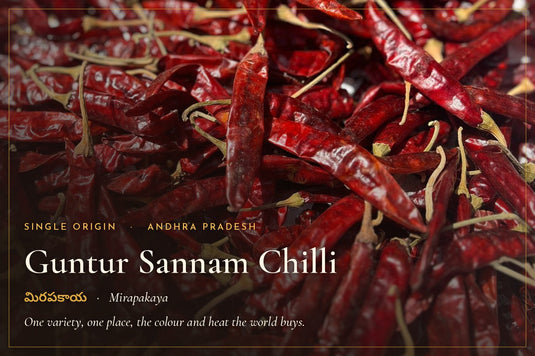
One variety, one place, the colour and heat the world buys.
Open a packet of red chilli powder anywhere in India and there is a fair chance the colour came from Guntur. Most of us cook with chilli every single day and never stop to think about where it grew, or that it has only been on Indian soil for about five hundred years. This is the story of one chilli from one place, the Guntur Sannam, and why its colour and heat travel further than almost any other.
Where the chilli capital grows
Guntur sits in the coastal plains of Andhra Pradesh, a short drive west of the Bay of Bengal, in a belt of hot, dry days and dark, moisture holding soils. Chilli takes up close to three quarters of the district's horticulture land, which is how Guntur earned its name, the chilli capital of India.
At the centre of it is the Guntur Mirchi Yard, the largest dried red chilli market in Asia. So much chilli changes hands there that the prices set in that yard ripple outward to buyers around the world. The same crop carries on into Prakasam, and across the border into the Warangal and Khammam side of Telangana, but Guntur is the heart of it.
What we call it
In Telugu, chilli is mirapakaya, and this variety is guntur sannam mirchi. Travel across India and the word changes with the language.
Kannada Menasinakayi · Bengali Lanka · Marathi Mirchi · Gujarati Marchu
The name Sannam is Telugu too. It means thin or long, and it describes the slender, tapering pod. You will also see it sold as S4, sometimes written 334. That is the trade grade the variety is bought and exported under across the world, so guntur sannam and S4 are the same chilli, named once for its shape at home and once for the market abroad.
How a New World fruit became Andhra's crop
Chilli is not Indian by birth. It is American. Wild capsicums first grew in South America, and people there were cultivating them more than six thousand years ago. It reached India only after Vasco da Gama opened the sea route to the Malabar Coast in 1498, and the Portuguese made Goa their base in 1510. They carried chilli seed from their colony in Brazil, and in Goa the new spice was first known as Pernambuco pepper, after the Brazilian region it came from.
Before chilli arrived, the heat in Indian food came from black pepper and from pippali, the long pepper. The newcomer took to the southern climate at once. Within about thirty years there were already several kinds of chilli growing around Goa, and from there it spread quickly through the south, reaching the north only much later. Today India grows more chilli than any country on earth, close to half the world's crop, and exports more of it than anyone else. Guntur sits right at the centre of that trade.
Guntur Sannam, sold as S4, is thought to account for roughly thirty percent of all the chilli India exports, with an annual harvest in the region of two hundred and eighty thousand tonnes. Guntur's fields also yield well above the Andhra Pradesh average, which is part of why this one district, and this one variety, set the tone for the wider market.
What is inside the pod
Two things make a chilli worth talking about, its heat and its colour, and Sannam is prized for the balance of both. The heat comes from capsaicin, which sits mostly in the seeds and the pale inner ribs rather than the flesh, and is measured on the Scoville scale. Sannam lands in the medium range, somewhere around thirty to forty thousand units, hot enough to matter without burning a dish out.
The colour comes from a different family of compounds, the red carotenoids capsanthin and capsorubin. That deep red is what a buyer means when they talk about a chilli's ASTA colour value, and Sannam carries plenty of it. Its thick skin means more flesh per pod, and more flesh means more colour. That combination, a real, steady red with a moderate and even heat, is exactly why it ends up in so many spice blends and so many kitchens.
Why we send it single origin, sun dried, and whole
Most chilli on a shop shelf is blended. Pods from many lots and growing areas are pooled together, so the heat and the colour drift from one packet to the next. Ours does not work that way. It is one variety, Guntur Sannam, from the belt around Chilakaluripet in Guntur district, registered as a Geographical Indication by the Government of India.
It is sun dried the traditional way, the pods laid out under the Andhra sun for several days until the moisture falls and the colour deepens, and we send it as whole pods rather than powder. Whole, it holds its aroma far longer, and you grind it fresh in the quantity you need, so what reaches your pan still smells of the field. You can read the full sourcing and grade detail on the Guntur Sannam S4 product page.
Cooking with Guntur Sannam
Used whole, the pods are made for tempering. Slip two or three into hot oil or ghee at the start of a dish, let them darken for a few seconds, and they release a warm, round heat and a gentle smokiness into everything that follows. Ground fresh, Sannam is a colour first chilli, the backbone of Andhra gravies, pickles, and home made podis, where you want a deep red and a clean heat rather than a searing one.
For colour with very little heat, split the pods and shake out the seeds and the stems before you grind. The red stays and most of the burn goes. It sits naturally alongside the rest of a South Indian shelf, turmeric, black pepper, curry leaf, and mustard.
A chilli with an address
Most chilli is anonymous. This one has an address, a single variety from a single district that happens to be the place the rest of the country, and a good part of the world, buys its red from. Grind a little fresh and you will taste the difference between chilli in general and a chilli from somewhere. Try our Guntur Sannam S4, or browse the rest of the single origin collection.
From Our Shelf