Pantry Notes
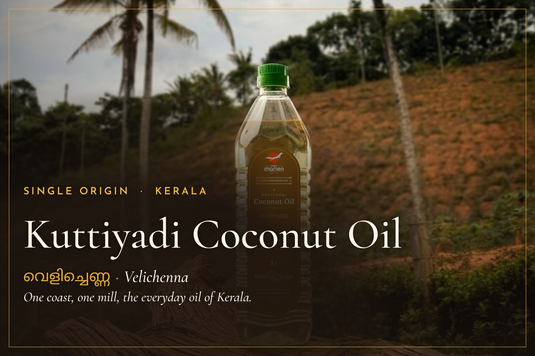
One coast, one mill, the everyday oil of Kerala.
Every Kerala kitchen keeps a bottle of it. Coconut oil is not a specialty ingredient here. It is the everyday oil, the one behind the first tempering of the morning and the last of the night. We wanted ours to taste the way it did before refining became the habit. So we went to Kuttiyadi.
A village in the north of Kerala
Kuttiyadi is a small town in the northern part of Kozhikode district, in the Malabar region of Kerala. It sits on the banks of the Kuttiyadi River, in the foothills of the Western Ghats, where the hills fall away toward the Arabian Sea. The monsoon arrives early here and stays long. The land is green, the air is wet for half the year, and coconut palms grow thick across it. This is the single place our oil comes from. Not a blend of many origins. One.
What velichenna means
In Malayalam, coconut oil is velichenna. The word points to a clear, bright oil. The same oil carries other names across India: nariyal tel in Hindi, thengaai ennai in Tamil, kobbari nune in Telugu, thengina yenna in Kannada. In a Kerala home you will also hear it called nadan velichenna, the native oil, a name said to mark the difference from the pale, scentless refined oil that fills most supermarket shelves. We named the bottle after the honest word.
- Malayalam Velichenna · വെളിച്ചെണ്ണ
- Hindi Nariyal Tel · नारियल तेल
- Tamil Thengaai Ennai · தேங்காய் எண்ணெய்
- Telugu Kobbari Nune · కొబ్బరి నూనె
- Kannada Thengina Yenna · ತెಂಗಿನ ಎಣ್ಣె
Copra, not coconut milk
There are two traditional ways to make coconut oil in Kerala, and they are not the same thing.
One begins with fresh coconut milk, simmered slowly in a brass uruli until the water leaves and the oil stays. That is ventha velichenna, also called urukku velichenna, a hot-processed oil long kept for skincare and ayurvedic use.
The other begins with copra, the dried kernel of the coconut. The husk is stripped, the shell is cracked, and the white kernel is laid out to sun-dry for weeks until the moisture is gone. That dried kernel is what gets pressed. This is the everyday cooking oil of Kerala, and it is the route we take. Our copra is sun-dried, slowly, under the same coastal sun the coconuts grew under. Nothing is rushed with heat.
Two oils, one coconut. Ventha velichenna is made from coconut milk and boiled down. Copra oil, the kind in this bottle, is pressed from sun-dried coconut kernel. They look alike and both are called velichenna, but they are made for different jobs. Ours is made for cooking.
Wood-pressed, not refined
Most coconut oil sold today is refined. The label may read RBD, short for refined, bleached and deodorised. Refining is done for a long shelf life and a flat, neutral taste. It also strips the colour, the aroma and most of the character of the oil.
We do none of that. Our copra is pressed in a traditional rotary mill in Kuttiyadi, the kind Kerala calls a chekku. It is a slow wooden press that turns without forcing heat into the oil. We press the copra twice, so very little is left behind. What comes out is unrefined. It keeps its soft gold colour, its coconut aroma and its real flavour. Nothing is added. Nothing is bleached away.
What is inside the bottle
Coconut oil behaves differently from most cooking oils, and a little chemistry explains why. It is roughly ninety percent saturated fat, and close to half of it is lauric acid, a medium-chain fatty acid. That composition is why coconut oil is firm at room temperature and why it cooks the way it does.
It has a smoke point of around 177 degrees Celsius, which is comfortable for the tempering, sauteing and shallow frying that Indian cooking asks of an oil.
It also sets solid below about 24 degrees Celsius. If your bottle turns cloudy or firm in cooler weather, nothing has gone wrong. That is pure coconut oil doing exactly what pure coconut oil does. Stand it in warm water for a few minutes and it pours again.
How to cook with coconut oil
Coconut oil is not a quiet background oil. It carries a clear, sweet, gently nutty aroma into whatever it touches. In Kerala it is the natural choice for the first crackle of mustard seeds and curry leaves, for a thoran or an avial, for fish curry, for erissery. It holds heat well, so it works for stir-frying and shallow frying too, and its aroma is a quiet gift in baking.
Use it where you want the dish to taste of the coast. Keep a neutral oil for the dishes that should not. Both have a place on the shelf.
An everyday oil, honestly made
We started Nilgiri Marten to do one thing properly: bring single-origin produce from a place you can name, traceable to the farm and the mill, with nothing hidden in the middle. Our Kuttiyadi Coconut Oil is our first cooking oil, and it follows the same rule. One region. One mill. Unrefined. Sold as exactly what it is, an edible oil for everyday cooking.
If you have only ever cooked with refined oil, the first thing you will notice is the smell. Try the Kuttiyadi Coconut Oil and let it change the first tempering of your day.