Pantry Notes
The story of the little black berry the ancient world called black gold.
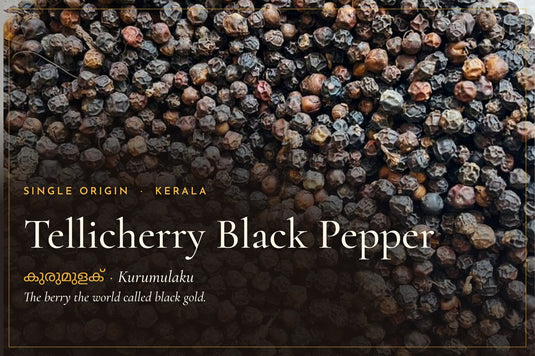
Pepper is so ordinary now that it sits in a shaker on every table, usually ignored. It is easy to forget that this same small black berry once moved fleets across oceans, drained the gold out of Rome, and was counted out like coins to settle rents and ransoms. All of it began on one strip of coast in south India, the Malabar shore of Kerala, where the pepper vine first climbed the trees, and where the grade called Tellicherry still comes from. This is its story.
Where pepper actually comes from
Black pepper is not from everywhere, the way the shaker on the table suggests. Piper nigrum is native to the Malabar Coast of present day Kerala, the band of monsoon hills along India's south west edge. It is a climbing vine that needs a tree or a pole to grow up, takes a few years to come into bearing, and carries its fruit in long hanging clusters called spikes. For most of recorded history, this coast was the only real source the world had.
The pepper we send comes from the Malabar belt of north Kerala, the registered home of Malabar Pepper, around Wayanad, Kannur and Kozhikode. The vines grow in deep laterite soils through a humid season with heavy monsoon rain, roughly 1,250 to 2,000 mm a year. That long wet season, and the slow ripening it allows, is part of why Malabar berries carry the aroma they do. The port that shipped this pepper to the world was Thalassery, which the British spelled Tellicherry, and the grade still carries the port's old name.
What we call it
In Malayalam, pepper is kurumulaku. Travel across India and the word changes with the language.
Kannada Karimenasu · Bengali Golmorich · Marathi Miri · Gujarati Kali Mari
Sanskrit had a name for it too, Yavanapriya, which means dear to the Yavanas, the Greeks and Romans who could never get enough of it. As for Tellicherry, it is worth knowing that the word is not really the pepper's birthplace on a label. It is a size grade. The largest, ripest Malabar berries are sorted, or "garbled", over sieves, and only the big ones pass: 4.25 mm and over as Tellicherry, and 4.75 mm and over as Special Extra Bold, the top of the ladder.
The spice that moved the world
No spice has a history quite like pepper's. The Romans were besotted with it. Pliny the Elder, writing around 77 CE, grumbled that there was "no year in which India does not drain the Roman Empire of fifty million sesterces", a great deal of it spent on pepper from the Malabar Coast. Rome sent fleets east on the monsoon winds to the Kerala port of Muziris, near present day Kodungallur, and brought the cargo home to dedicated pepper warehouses, the horrea piperataria, in a spice quarter of the city. An ancient merchant's guide, the Periplus of the Erythraean Sea, written around 70 CE, describes Roman coin changing hands for pepper at these Malabar ports.
By the late empire, pepper was treated almost as money. When Alaric and his Visigoths besieged Rome in 408 CE, the ransom they demanded listed 5,000 pounds of gold, 30,000 pounds of silver, and 3,000 pounds of pepper, the spice named in the same breath as the precious metals. Centuries later, the wish to reach the source and cut out the middlemen is what drove the Age of Discovery. When Vasco da Gama landed near Calicut on this same Malabar Coast in 1498, opening the first sea route from Europe to India, it was pepper he had crossed the oceans for.
Pepper was once so valuable that tenants paid their landlords in peppercorns, and dowries and taxes were settled in it. The phrase "a peppercorn rent" survives in English law to this day, though it now means a token, next to nothing payment. When it was coined, it meant the opposite, a sum worth real money.
What makes a peppercorn Tellicherry
Black, green and white pepper are all the same fruit, treated differently. A peppercorn is a small dried berry, a drupe. For black pepper the berries are picked as they begin to ripen and dried whole in the sun, and as the green skin dries it wrinkles and blackens into the corn you know. Tellicherry is not a different plant, it is a grade. The trick is patience: the berries are left to ripen late on the vine so they grow larger, and after drying they are sieve graded, so only the biggest berries earn the name.
That size is the whole point, because a peppercorn is mostly skin and the aromatic oil lives just under it. A larger, thicker skinned berry holds more of that essential oil, which gives a more complex, fruity, almost citruslike aroma, while its raw heat turns rounder and more balanced. The bite itself comes from piperine, the alkaloid that black pepper carries at roughly 2 to 8 percent, with the late picked Malabar berries at the higher end. The simple lesson for the kitchen is that a bigger Tellicherry berry is not hotter, it is more aromatic.
Only about a tenth of a Malabar harvest grows large enough to be sieved out as Tellicherry, and a smaller share again reaches the top Special Extra Bold grade at 4.75 mm. That scarcity, not a different variety of plant, is what the grade name is really telling you.
Why we send it whole, from one coast
Most pepper on a shelf is anonymous, blended from many lots and growing areas and often ground months before it is sold. Ours is one origin, the Malabar belt of north Kerala, the native home of the vine. It is sun dried, and we send it as whole peppercorns rather than powder. The moment a berry is cracked its volatile oil starts to escape, which is why ground pepper smells wonderful for a week and then fades. Whole, the oil stays sealed in the berry until you grind it, so a mill of fresh Tellicherry over a dish has a fragrance a tin of pre ground pepper simply does not. You can read the full grade and sourcing detail on the Tellicherry Black Pepper product page.
Cooking with Tellicherry pepper
Used whole, the corns are made for slow cooking. A few dropped into a biryani, a rasam, a stock or a pickling brine will perfume the whole pot, and they belong in a garam masala ground fresh. Cracked coarse, Tellicherry is a finishing pepper, scattered over steaks, eggs, salads and roasted vegetables, ideally stirred in near the end so the aroma survives the heat rather than cooking away.
For everyday use, grind it fresh in a mill as you cook, and if you want a deeper, smokier note, warm the whole corns in a dry pan for under a minute until they are fragrant before grinding. On a Kerala shelf it sits naturally beside turmeric, cardamom, clove and curry leaf, and pepper with turmeric is one of the oldest pairings in the southern kitchen.
A berry with an address
Most pepper is just grey dust at the back of a cupboard. This one has an address, the coast that gave the world the spice it once counted as treasure. Grind a little fresh and you taste the difference between pepper in general and pepper from somewhere. Try our Tellicherry Black Pepper, or browse the rest of the single origin collection.
From Our Shelf