


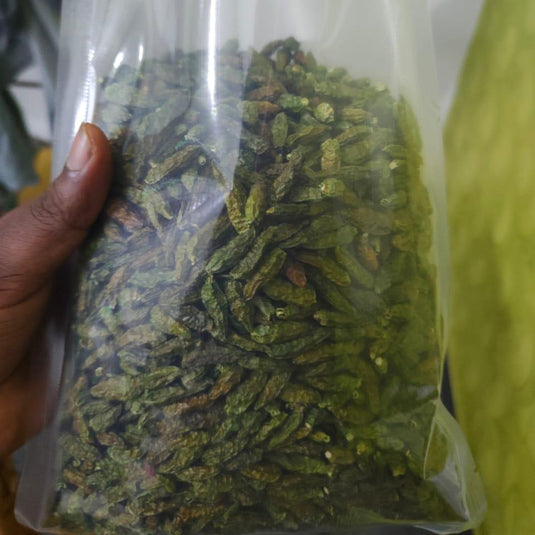
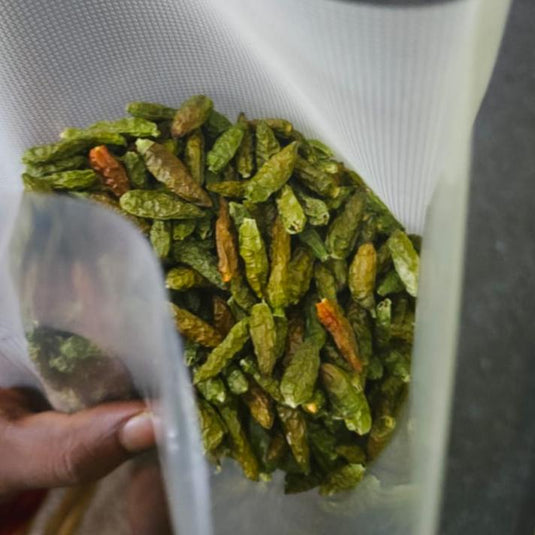
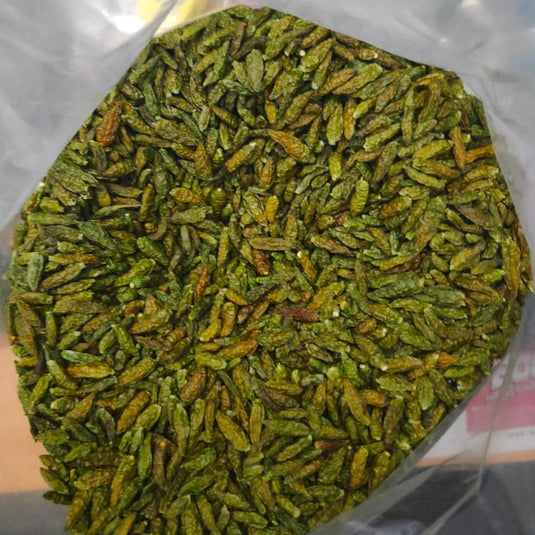
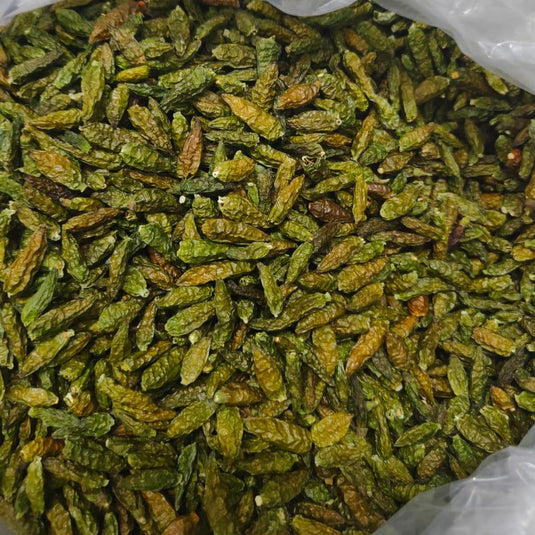
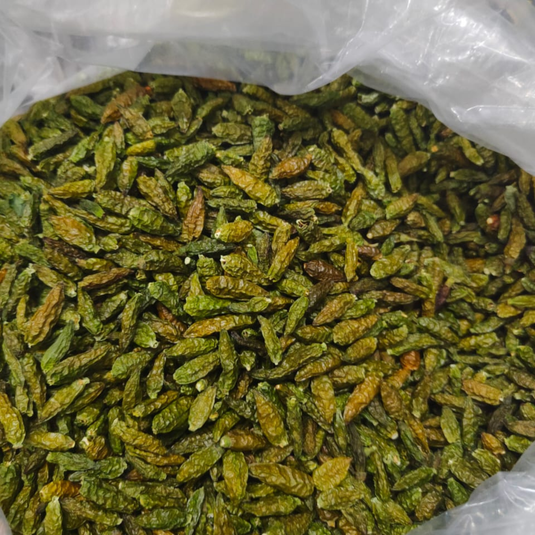
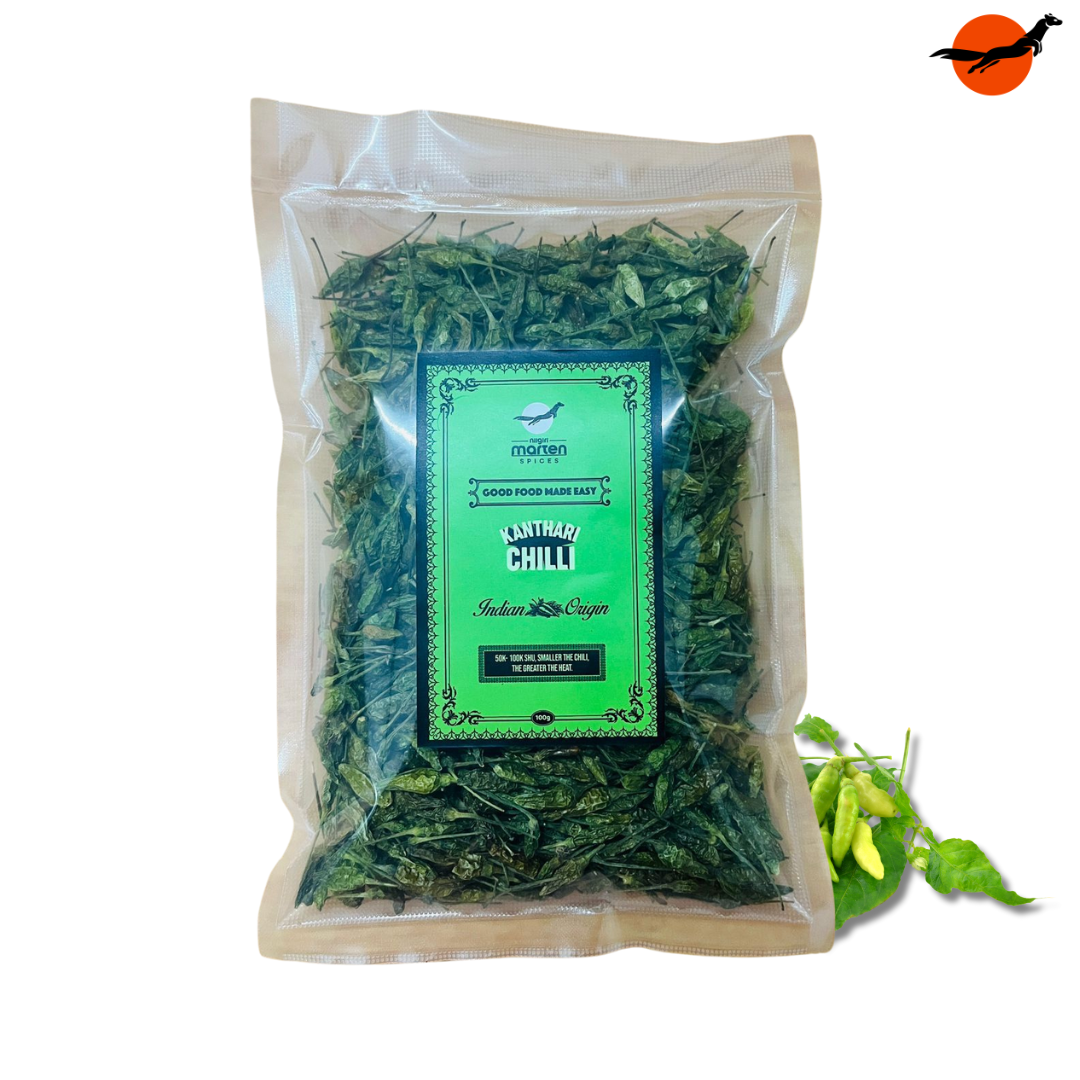
Kanthari Bird's Eye Chilli, Green Dried (Kanthari Mulaku) | Single Origin Kerala
We will send you a notification as soon as this product is available again.
Guarantee safe and secure checkout
-
Estimated delivery: Jun 26 - Jun 30
-
Free return within 30 days of purchase.
Product description
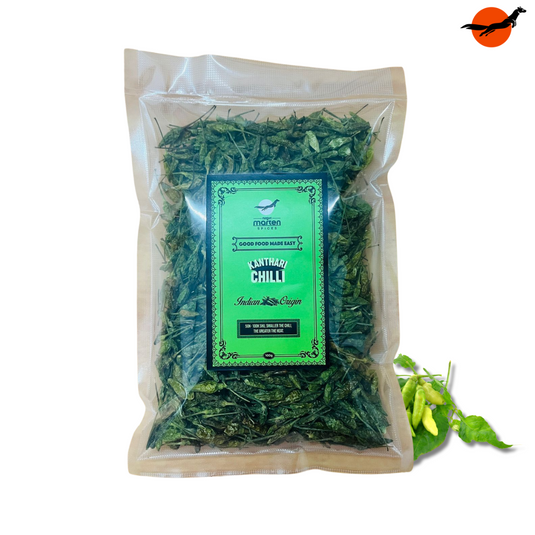
The Green Dried Bird's Eye Chilli From the Edge of Nagarhole
In the homestead gardens along the Kerala and Karnataka border, a tiny chilli grows half wild, sown as much by birds as by hand. This is that chilli, the kanthari, picked and dried while still green, single origin from the forest edge of the Western Ghats.
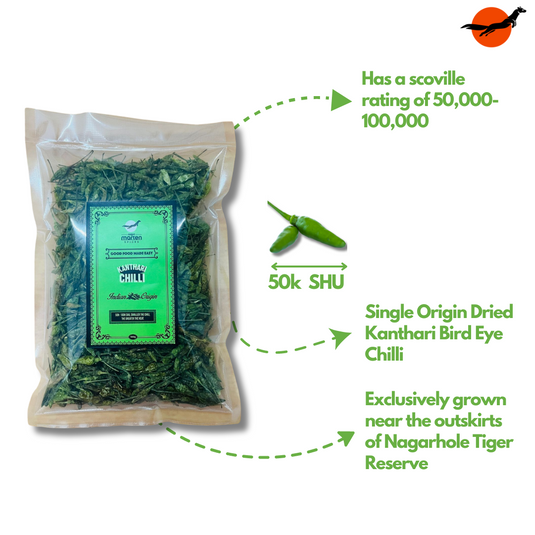
Scoville units measure heat. Kanthari is tiny, but at fifty to one hundred thousand it runs roughly ten to twenty times hotter than a jalapeno.
This is the kanthari, Kerala's homestead bird's eye chilli, the little green pod that grows half wild in backyard gardens and forest clearings rather than open fields. Whether you grew up crushing it into buttermilk and chutneys and want the real single origin version, or you simply want a chilli with a fierce, fruity heat that no shop packet keeps, this gives you that, picked and dried while still green, from one stretch of the Western Ghats.
The Place: Where Kerala Meets Karnataka, on the Forest Edge
Our kanthari comes from the villages strung along the Kerala and Karnataka border, in the Wayanad and Kodagu hills that sit on the edge of the Nagarhole tiger reserve, deep in the Western Ghats. This is high, wet, forested country, with humid air, heavy monsoon and the slightly acidic, humus rich soil that this chilli likes.
Kanthari is not a field crop here. It grows in homestead gardens and in the clearings at the forest edge, often springing up on its own from seed that birds have scattered, and a single plant lives and bears for years. That half wild way of growing, in this one belt of country beside the reserve, is part of what gives the chilli its sharp, clean, fruity heat.
One Family, Three Chillies: Know What You Are Buying
Bird's eye is a family of chillies, not a single one, and they are easy to confuse. They look alike and are all fiercely hot, but they are different varieties from different places. It is worth knowing which one is in your hand.
The prik kee noo of Thai cooking, a cultivar of Capsicum annuum. The chilli most shops abroad simply label bird's eye.
The South Indian bird's eye, Capsicum frutescens, grown half wild in Kerala's gardens. Picked and dried green, with a fierce, fruity heat around fifty to one hundred thousand Scoville.
The piri piri of East and West Africa, a Capsicum frutescens cousin from the same species. Hotter still, often one hundred and fifty thousand Scoville and up.
From Garden to Pod: How It Is Made
- Grown half wild. Kanthari is a perennial backyard chilli, often self sown from seed dropped by birds, growing in homestead gardens and forest clearings rather than in open fields.
- Picked green. The tiny pods are hand picked while still green, before they ripen to red, which is when this chilli carries its sharpest, most fruity heat.
- Sun dried. Spread and dried in the sun until the moisture is right, holding the green colour rather than letting the pods redden.
- Cleaned and packed whole. Stems and debris are removed by hand and the pods are sorted, then sent to you whole rather than ground.
The chilli that birds plant
The name is no accident. Birds love these little chillies, and unlike us they cannot feel the heat, because capsaicin, the compound that burns a mammal, simply does not register on a bird. They eat the pods whole and scatter the seed across the gardens and forest edges, which is why kanthari springs up half wild wherever it grows. The chilli that birds named is also the chilli that birds sow.
Why We Send Them Whole, and Green
Ground chilli loses its aroma and bite quickly, because grinding opens every surface to the air. Whole pods hold both far longer, so you can crush or grind small amounts as you need them, or drop them in whole for a tempering. And we dry them green rather than letting them ripen to red, which keeps that sharper, grassier, fruity heat, closer to a fresh green chilli than to a deep red one.
A little goes a long way. At fifty to one hundred thousand Scoville, one or two crushed pods can carry a whole dish, and most of the heat sits in the seeds and the pale inner membrane that holds them. Start with less than you think, and wash your hands well after handling.
One Chilli, Three Ways
A pod or two crushed with shallots and salt into buttermilk, a coconut chutney, or a fiery kanthari chammanthi.
Dropped into hot coconut oil with mustard and curry leaf at the start of a thoran or a fish curry.
Ground into a sharp green chilli powder, or steeped into pickles, hot sauces and infused oils.
Why Choose Our Kanthari
- Single origin. From the homestead gardens along the Kerala and Karnataka border, not pooled from many sources.
- Picked green. Dried while still green for a sharp, fruity heat, not the usual ripe red.
- Fierce but fruity. A true bird's eye, around fifty to one hundred thousand Scoville, with a clear fruitiness under the fire.
- Sold whole. Whole pods rather than powder, so the heat and aroma stay in.
- Honest by nature. Just chillies, sun dried, with nothing added.
Kerala's wild little chilli, traced to the forest edge that grows it.
| Type | Whole dried green bird's eye chilli, Kanthari |
|---|---|
| Origin | Kerala and Karnataka border villages near Nagarhole, Western Ghats |
| Botanical name | Capsicum frutescens |
| Also called | Kanthari Mulaku (Malayalam), Kadagu Molagu (Tamil), Kandhari Menasu (Kannada) |
| Heat | Very hot, about 50,000 to 100,000 SHU |
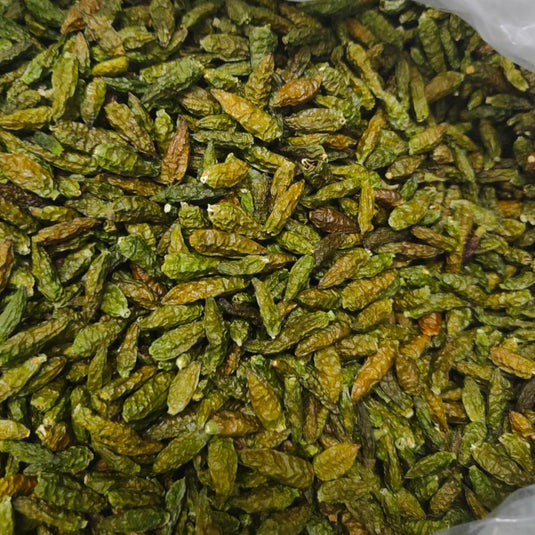
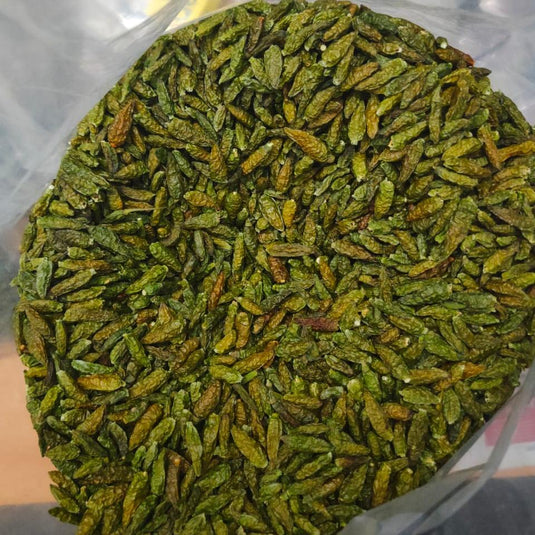
| Colour | Picked and dried green, not ripened to red |
| Pods | Tiny, about 1 to 2 cm, slender and pointed |
| Best for | Chutneys, pickles, buttermilk, temperings, hot sauces, infused oils |
| Packs | 20g, 100g, 250g, 500g and 1kg |
About our Kanthari chilli
How hot is kanthari chilli?
Why is this chilli green and not red?
Are these whole chillies or powder?
Where does kanthari grow, and why does it matter?
Is kanthari the same as Thai bird's eye chilli?
How do I cook with kanthari?
How should I store dried kanthari?
Why is it called bird's eye chilli?
Additional information
| Name | Kanthari Bird's Eye Chilli, Green Dried (Kanthari Mulaku) | Single Origin Kerala |
|---|---|
| SKU | NMS0008-A |
| Vendor | Nilgiri Marten Spices |
| Weight | 20G, 100G, 250G, 500G, 1KG |
Shipping & return
Shipping
- Dispatch within 24 hours of order confirmation
- Free shipping on all orders above ₹1000 within India
- Flat ₹90 shipping on orders below ₹1000
- Delivery within 2 to 5 business days across India
- International delivery available, 7 to 14 business days depending on destination
- Cash on Delivery available on select pin codes at checkout
Returns and Exchanges
We pack every order with care and ship fresh from our Wayanadu warehouse. If something is not right, we will make it right.
- Damaged, expired, or incorrect items are eligible for replacement or refund within 7 days of delivery
- Notify us within 24 hours of delivery at aswinpk@nilgirimarten.com or WhatsApp +91 97783 07321
- Share a photograph of the damaged product and the outer packaging to help us process your claim quickly
- We do not accept returns on opened or used products, which is standard for food and spice products under FSSAI regulations
- Refunds are processed within 7 business days of return confirmation to the original payment method
- Return shipping costs are covered by us for damaged or incorrect items. For other returns, return shipping is the buyer's responsibility
Tracking and Delivery
You will receive a tracking link via email and SMS once your order ships. Deliveries are made Monday through Saturday. If you are unavailable, our courier will attempt delivery up to three times before returning the parcel. For any delivery issues, reach out to us on WhatsApp and we will coordinate directly with the courier.
International Orders
We ship to most countries worldwide. International customers are responsible for any customs duties or import taxes charged by their country. Please ensure your shipping address and contact details are accurate at checkout.